Truth About Dyslexia podcast
Dyslexia and ADHD Overlap: Why I’m Letting Go of Fixed Labels
A new Truth About Dyslexia episode on why dyslexia and ADHD can overlap in messy ways, especially around perfectionism, and why holding labels more lightly can make life easier.

Listen to this episode
Dyslexia and ADHD Overlap: Why I’m Letting Go of Fixed Labels
Open this episode in Spotify

Follow the podcast and keep the next episode close.
A new Truth About Dyslexia podcast episode is out now. Listen below, or read the practical ideas and personal reflections from Planning a Holiday with A Dyslexic and ADHD Brain.
What you will take from this episode
- Dyslexia and ADHD can share challenges, but people experience those overlaps differently.
- Perfectionism is not a neat, exclusive trait of either dyslexia or ADHD.
- A vivid internal picture can make it frustrating when real life does not match what you can see in your head.
- Years of feeling criticised or not good enough can feed a drive to avoid mistakes.
- Learning more about yourself should create curiosity, not become another rigid identity.
A new episode, and a messy but useful point
A new Truth About Dyslexia podcast episode is out now, and I want to talk about something that can get surprisingly sticky: how tightly we hold the labels of dyslexia, ADHD and neurodiversity.
Have you ever learned a trait belongs to one condition, then found someone saying it belongs to another? Maybe it was perfectionism, time blindness, communication, emotional intensity or attention. Suddenly it can feel like someone is arguing with your identity, not just using different words.
I get it, because I used to be terrible at holding this stuff lightly. The shift for me was realising that a label can help explain my experience without needing to explain every single thing about me.
I understood myself in stages
I was diagnosed with dyslexia at 10. But I did not really understand what dyslexia meant for me until my early 30s. For a long time, I thought it was mainly about reading, writing and spelling.
As I learned more, I started seeing how it could affect the way I think, feel, communicate and see the world. Visual thinking, in particular, helped a lot of my life make more sense.
Then, around my early to mid-30s, I was diagnosed with ADHD. That gave me more language for my attention challenges, impulsivity and some of the ways my brain works. But it also made things messier, because some of the challenges I had already connected to dyslexia seemed to overlap.
That is why I think it helps to remember that people are not tidy lists of traits. Two people may both be dyslexic, or both have ADHD, and have very different experiences. One person may not relate to something at all that feels huge for someone else.
If you are looking for more honest conversations around this stuff, you can browse the adult dyslexia podcast for other episodes and practical ideas.
The exact same point comes up in my episode on my earlier episode on dyslexia and ADHD overlap, where I talk more directly about not making labels too solid.
Perfectionism is not a neat label
Perfectionism was the example that got me thinking about this again. Someone emailed to say perfectionism was an ADHD characteristic, not a dyslexic one. Early on, I probably would have felt strongly about that sort of statement too.
But I do not think perfectionism fits cleanly into one box. People with ADHD can struggle with it. People with dyslexia can struggle with it. Some people experience it alongside both, and some do not experience it much at all.
For me, the useful question is not, “Which label owns this trait?” It is, “What might be driving this in my life?” That gives us more room to understand the actual challenge instead of arguing over the category.
I often see a kind of all-or-nothing pattern too. You can be extremely particular about one area of life, then feel like you have completely given up in another. That does not mean you are broken or inconsistent. It may simply mean different things carry different pressure for you.
I used to be very perfectionistic about how I lived. My room was tidy, clean and minimal. It helped my brain feel clear. Then I got together with my wife, and we had a little one. Keeping every part of life perfectly in line was no longer realistic, so I had to put systems in place and loosen my grip a bit. Most of the time, a bit of clutter is okay now.
When the picture in your head is clearer than your explanation
One place I see perfectionism show up for me is visual thinking. I can hold a very clear picture in my head, but getting that picture into the real world can be hard.
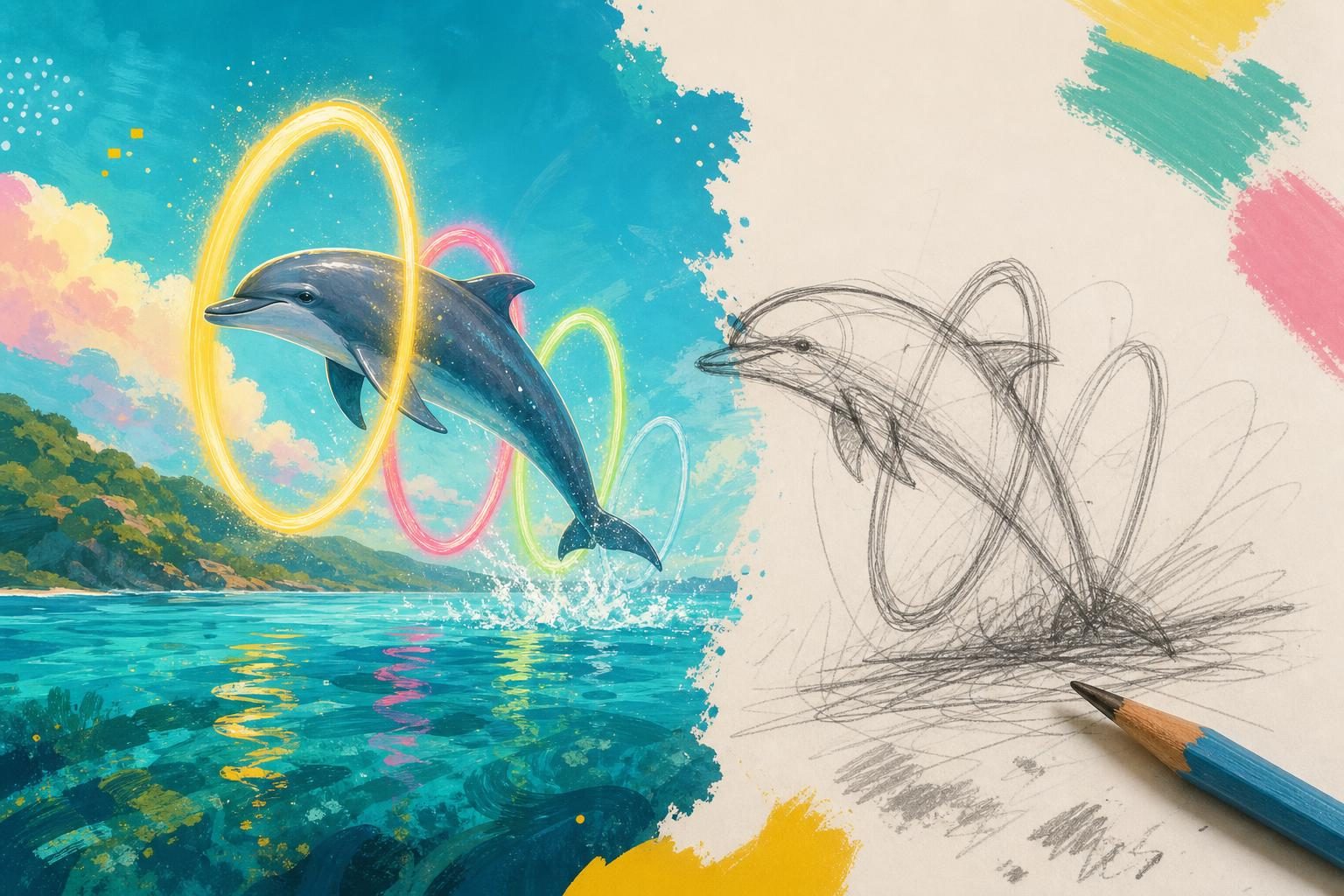
Imagine seeing a beautiful dolphin leaping through rings above the water. In my head, I can picture the water, the movement and the detail. But if I tried to draw it, it would not come out looking anything like what I can see. I would probably get a stick-figure dolphin and an okay ring, at best.
That gap can be frustrating. You know what you are aiming for, but you do not yet have the words, skills, time or tools to make it match. It can look like perfectionism from the outside, but it may be the friction between a detailed internal picture and what is possible to express right now.
I notice this at work as well. I can picture how a website should look, then struggle to explain every part of that picture to my team. If the result does not match what I had in my head, I can keep pushing back on small details. Not because I want to make everyone’s life difficult, but because I have not managed to communicate the picture clearly enough.
If you recognise the visual side of this, 20 Things Adults Need to Know About Dyslexia may help put more language around how dyslexia can show up beyond reading and spelling.
Perfectionism can also be about protection
There is another reason perfectionism can become a big deal for neurodivergent people, and it is less about the trait itself and more about what we have been taught over time.
A lot of us spent years hearing messages like, “You should be able to do this,” “Try harder,” “Sit still,” or “Why is this so difficult for you?” When mistakes are repeatedly noticed, it is easy to start believing that getting things wrong means you are not good enough.
Then perfection can start to feel like protection. If the email is perfect, maybe nobody will judge my spelling. If the work is perfect, maybe people will accept me. If I do not make mistakes, maybe I will not feel that old sting again.
I am not saying this is true for every person with dyslexia, ADHD or another neurodivergent way of thinking. It is simply a pattern I have seen, and one worth gently noticing in yourself. The need for everything to be right can sometimes be carrying a much older fear underneath it.
For a fuller look at the everyday realities that can sit behind adult dyslexia, have a read of 20 Things to Remember if You Love Someone With Dyslexia.

Let learning make you more curious, not more fixed
When we first discover a framework that explains us, it can be tempting to grab onto it hard. I have done it. I once decided to become vegan for about two and a half weeks. For those two and a half weeks, I was convinced I was probably the best vegan in the world. Then I decided it was too hard.
That is a silly example, but the point is real. When something gives us an answer, especially after years of confusion, we can quickly turn it into a fixed part of who we are.
I am not saying labels are bad. Dyslexia and ADHD gave me helpful language and helped me understand things that used to make no sense. But the language needs to stay useful. It should not stop us listening, learning or changing our mind when new information turns up.
So, if you have learned that perfectionism is connected to ADHD, that may be useful. It does not mean it cannot also be connected to your dyslexic visual thinking, your past experiences of criticism, or something else entirely. More than one thing can be true.
If you are still working out whether adult dyslexia might be part of your picture, the free adult dyslexia quiz is a simple educational place to start.
Hold the labels lightly, and keep learning
The main thing I want to leave you with is this: do not beat yourself up if something you once believed changes as you learn more. That is not failure. That is learning doing its job.
When a trait comes up this week, try asking yourself what is actually happening for you, rather than rushing to decide which label it belongs to. A little curiosity can make life a lot easier than trying to keep every part of yourself in the perfect box.
Listen to the episode, then take one small next step: notice one fixed belief you have about your brain and see if there is room to hold it a bit more lightly.
Read the full episode transcript
Hey everybody, Stephen here from the Truth About Dyslexia. In today's episode, I want to talk a little bit about how dyslexia and ADHD overlap, how neurodiversity is becoming a big word, and why I think it's really important to not hold things too tight about how you see things. And I've got a couple of good examples of how I've learned to do this because I used to be terrible at it as well. So let's dive into this. Okay, so this topic is a bit of a hard one, so bear with me as I try and explain my point of view here, because I think it's really important. And the distinction of this was game-changing in the way I saw myself.
Now, I've spoken about how I got diagnosed with dyslexia at the age of 10, and then I didn't get diagnosed with ADHD until, I want to say 33, 34. It's all blurry, but it's about five years ago, give or take, and how I didn't really understand what dyslexia was till I was in my early 30s. So I had different variations of myself as I learned more and more about these challenges. When I first learned about dyslexia, I thought it was just reading, writing, spelling. That's all I understood. When I found out more about how it impacts the way I think, feel, how I see the world, my perceptions, I was like, wow, this is amazing.
I didn't know any of this, and it all made so much sense. How my brain thinks visually and how visual pictures affect and impact my day-to-day life, all of this other stuff. I then learned about all these, what should we call them, these symptoms that appear because of the way I think and the way my life has shaped because of dyslexia and/or ADHD. And then when I found out later I had ADHD as well, it made a lot of sense. I could understand where my attention challenges were. I could understand where my impulsivity came from, and just the way my brain worked in that respect.
So. The challenge with it all is that many of these life challenges come with a bunch of, I hate the word comorbidities, but symptoms that appear that can appear for one or for both of them. In some people, they don't appear at all. So this is the biggest challenge with both ADHD and dyslexia. And to be honest, I feel, you know, and I've seen mixed bags of everybody, so many different people with different challenges that some of them I don't experience at all. And, you know, the one that was raised to me in an email recently, which was well received, was around perfectionism.
And the person who sent that to me, and I won't name names or anything, mentioned that, oh, perfectionism is an ADHD characteristic. It's not dyslexic. Now, very early along, I 100% felt the same way, but sometimes the opposite, because I knew a lot more about dyslexia than I knew about ADHD when I first started, 100%. And that was, and I kind of built this, you know, especially when you're learning about this, you build an identity around these challenges, and you're like, because I'm dyslexic, I have this challenge, or I need this exemption, or this, this, this, this. And I truly went down that path, and I really believed in what I'd learned and how I'd learned it, and it made logical sense. And then I learned about ADHD, and I saw that some of the challenges in ADHD matched the same as the ones I'd learned about in dyslexia.
And for a while it was really tough. I'm like, no, that's a dyslexic trait. It's not an ADHD trait. There was a part of me that was kind of fighting against, let's just say words, you know, realistically. It was, I was fighting against a way people... You know, used words.
That was all it was. It was literally different perceptions of similar challenges. And it took me a while to get my head around and be very open to accepting the crossover of dyslexia and ADHD and how things appear. And this example around perfectionism is actually a fantastic one, because a lot of people are told you become a perfectionist if you've got ADHD. But realistically, there's no specific ADHD factor that makes you a perfectionist. You know, being inattentive, that's not a perfectionist base.
Attention is not perfectionism either. You know, people say, oh, it's hyperfocus. That's not attention to detail, because I'll guarantee you, once you're out of hyperfocus, you're not caring about being perfect. I'll guarantee you that. So, like, there's a bunch of things that don't specifically relate to ADHD, but people with ADHD have perfectionism challenges. A hundred percent, they do.
With dyslexia, the same thing: perfectionism challenges. But you also, what I see so often with both of these challenges, especially with dyslexia, is the bell curve challenge. And again, I see this in ADHD as well. This comes across people with both diagnoses, where you're either one or the other. You're either a complete perfectionist or you've given up in a lot of ways. And sometimes you can have a bit of both.
You can be a perfectionist about something, and in other places you've just completely given up. Like, I used to be a perfectionist about how I lived. My room was so tidy, clean, minimalistic, and I was very,I don't want to say anal is the wrong word, but, you know, it helped my brain. Everything was clear. I was very focused. And then when me and my wife got together, she, you know, she's a bit more, you know, I need things left out so I know where things are, and we've got a little one, so, you know, good luck trying to keep everything in line.
And so I had to literally,I kind of went the other way. I had to put in some systems to make it work, but I kind of went the other way, and I've hopefully most times become a lot more the opposite side. I'm not a perfectionist around minimalism. I'm kind of like, I'm okay. You know, a bit of clutter, a bit of mess is there. I do have my challenges.
I'm sure my wife would tell you that. Don't worry. But, you know, it's both sides of the coin, and it's not specifically an ADHD or a dyslexic trait. Like, with dyslexia, there are studies out there. There's one I can even link to in the show notes. Around where they've actually done research.
And the perfectionism side is not,it's not like there's a part of your brain that makes you a perfectionist or not. There's not like a chemical of perfectionism. It just doesn't exist. But the way I see it around perfectionism and dyslexia, where it comes in is our brains can create quite visual pictures. We can create quite clear designs in our heads, okay? I can picture, you know, a beautiful, let's say a dolphin swimming through the water, a beautiful picture of a dolphin swimming through the water, maybe it's jumping out and going through some rings that are just in the air.
It's amazing. Every detail of water, every droplet is just stunning, absolutely stunning. Now, if I wanted to draw that, it's not going to take me two minutes. It's going to take me ages. I don't have the skill set nonetheless. So if I started to try and draw that picture, it would look like a stick figure dolphin jumping,I could probably get the ring right,jumping through the ring on a weird angle.
It would look horrible. And I'd be like, That's terrible. That's absolutely terrible, because I can't take the picture out of my head and put it into reality. Now, that's a real literal example, but the same happens at work and in relationships. I can picture how some part of my work is needed, and maybe I can see a website, because we design websites, I could see a website and how I want it designed. Now, when I try and brief my team on what I want, because of my dyslexia, I really struggle to communicate and get all of my picture out of my head verbally so that they can create the perfect thing that's in my head.
And what I think, I think is perfect. And so when they can't deliver that, it creates communication issues. I keep pushing back. You've all heard of the move two pixels, two pixels thing, because I've got such a clear picture in my visual head that I can't get right. And so to me, that is where my perfectionism comes from. It doesn't touch the sides of ADHD.
It just doesn't. But on the other hand, where other people pick up the perfectionism side is that many kids with both dyslexia and/or ADHD went through years and years of being told they're not quite good enough, or sit still, or stop looking out the window, or, you know, you should be able to read or write better, you know, or this shouldn't be that hard for you. You know, we all, especially in the early days, people just weren't diagnosed, so this was coming through a bit of everywhere. Okay, so this was coming across the bat. So what happens is, you know, over time, they just, they start to build up this questioning inside, you know, and they start to worry that I'm not good enough. I keep getting things wrong.
How do I get things right? You know, that's the real pain, is that they want to get everything right. And, you know, over time they say, well, if I was perfect, or if I got, if I didn't make as many mistakes, I would be wonderful. You know, I'd be, people would accept me. And that's the big one, people would accept me. And so they start to build this way of wanting everything to be perfect so they don't get judged.
And this judgment just comes up because they felt judged all their life for different things. I see this across, and if I'm honest, it's a neurodiverse thing. It's really a neurodiverse challenge, this perfectionism side. And so, like, they see this all again. An example I saw in a video recently was about someone who, when they wrote emails, they hated the idea of imperfect emails because it would look stupid, that their spelling was wrong, and that they would be shunned. And so perfectionism, in my opinion, doesn't come directly from either any neurodiversity.
From what I've seen and experienced in my own life, it comes from across the board. And I think we can get very tight, and this is perfectionism is just an example. There's a heap of other things. You know, you can also have, you can also make an argument around time, where that sits. I think time sits an issue for those with ADHD and an issue for those with dyslexia, and slightly different reasonings, and I can do another podcast on that. But what I would say is, and I know this is very hard for a lot of us, is when we get really focused and learning about learning something, in doubling down on it, we really believe what we've read, and it kind of becomes an instant identity for us.
You know, I always explain this one like once I decided to become a vegan for about two and a half weeks until I went, Nope, that's too hard. But for those two and a half weeks, I could tell everyone I was the best vegan in the world, and I probably was for two and a half weeks. And you know what I mean? Like, it's this, we get this real strong focus. And what I would say is start to learn to let go of things as not being quite as solid as we may think. Things might be wrong, and it might not be a problem you've made.
You may have just learned it a certain way, but it can also be right in other factors, and just to be okay about that. Just to not let it sink into your identity so much that you can't change it, that you become so incurious about what could that mean. So, for example, perfectionism. Maybe you have learned that it is an ADHD challenge. Great, fantastic. But that doesn't mean that it isn't a dyslexic challenge as well.
For different reasons, and potentially some of the same. There's probably crossover. And that's the same with everything in life, really. But for what we're talking about today is don't get too fixed. Don't beat yourself up if you learn something one way and you learn a bit more about it next. That's the rest of everyone's life.
It doesn't matter what you are, who you are, learning will never stop. But it's how you receive that learning that will change the way you act in your life. So that's all I want to share today, guys. I hope that's added some value. I hope it's got you thinking. Hope it's got you letting go of maybe some fixed beliefs you've got.
Maybe something will come up in the next couple of days and you can just play with it a bit and not be too worried if it's not quite what you always thought it was. Because I'll tell you, once you learn how to do this, it makes life a lot easier. Hope that's added some value. Have an excellent day. Stephen out. Thanks for listening to the Truth About Dyslexia.
This podcast is sponsored by Added Nutrition and our new product, Added Sleep. It's designed for brains wired differently. If you want to sleep better, maybe give it a try. Use the code Truth About Dyslexia to get a $10 credit on your order at addednutrition. com. Link in the show notes.
Recognise some of this?
Take the free quizSee which adult dyslexia traits feel familiar.
This short quiz is educational and gives you a useful next step.
Keep exploring this topic

Useful reading and listening for your next step.

Listen next