Truth About Dyslexia podcast
Finding Meaning When Life Feels Heavy: Create Hope You Can Move Towards
When life feels heavy, it can seem like everyone else has it figured out. I share what I took from hearing Mark Manson speak about shared struggles, hope and choosing meaning for yourself.

Listen to this episode
Finding Meaning When Life Feels Heavy: Create Hope You Can Move Towards
Open this episode in Spotify

Follow the podcast and keep the next episode close.
What you will take from this episode
- Nobody gets a perfect, problem-free life, even when it looks that way from the outside.
- Hope can give us a direction when sadness, anger or uncertainty are present.
- I do not think meaning has to arrive fully formed. We can choose what matters and build towards it.
- Small, personal hopes around family, home, finances or work can still be deeply meaningful.
- If you are feeling truly hopeless or unsafe, reaching out to someone you trust or a qualified professional is an important next step.
When everyone else seems to have life sorted
Have you ever looked at someone and thought, “They just seem to have it all together”? Calm, present, liked by everyone, not endlessly replaying the past or leaping three years into the future in their head.
I used to do that a lot. I especially noticed people who seemed completely unbothered by what others thought of them. From where I was standing, they looked like the opposite of my experience with dyslexia and ADHD.
But I went along to see Mark Manson speak recently, and one idea landed hard: everybody is dealing with something. Not in a fake, cheerful “we’re all the same” way. More in the sense that no one gets through life without internal battles, baggage, doubts or difficult bits.
That does not make your struggle disappear. But for me, it takes a little pressure off the story that I am uniquely behind, broken or getting life wrong.
If you want more honest conversations about the messy, real side of neurodivergent life, have a listen to the adult dyslexia podcast.
Everybody has problems, including the people you envy
Mark’s way of putting it was that everybody is screwed. It is blunt, but I get the point. We can spend a lot of energy comparing our behind-the-scenes mess to somebody else’s polished outside.
The person you think has the perfect life may be carrying challenges you cannot see. They may not be dyslexic or have ADHD, but that does not mean they are free from worry, grief, relationship problems, fear or their own noisy internal dialogue.
This also reminds me of something I learned years ago: when someone is pointing one finger at you, there are three pointing back at them. A lot of what people say or react to is tangled up with their own stuff. It is rarely a perfectly objective verdict on you.
That is useful to remember if you tend to take comments personally, overthink conversations or feel like every awkward moment proves something about you. It probably does not.
How to find meaning when life feels heavy
The other part of this idea is bigger. I started reading Mark Manson’s book, Everything Is Fucked: A Book of Hope, after the event. The opening is deliberately confronting: our lives can feel small in the scale of the universe, and we can overestimate how central we are to everything.
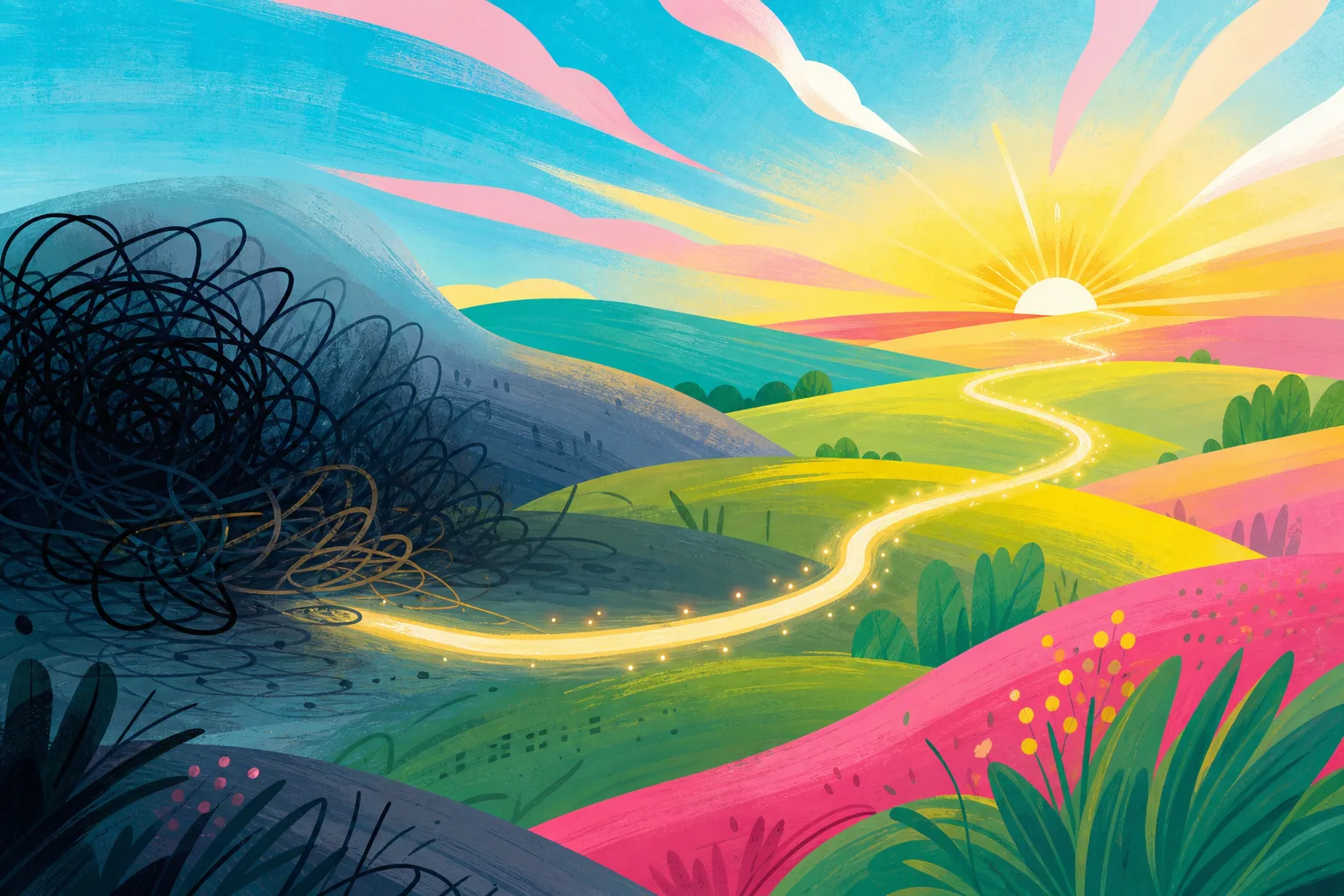
That could sound bleak. But I found the next part much more freeing. If there is not one external, pre-written purpose waiting to be handed to me, then I can have a role in choosing what matters.
At the talk and in the book, Mark framed hopelessness as the real opposite of happiness. I am not presenting that as a clinical fact, but I can see why the thought struck me. When you are angry or sad, there can still be something you wish was different. There is still a direction in there. When you feel hopeless, it can feel like there is no direction at all.
For me, hope is not pretending everything is great. It is having something real to move towards, even if it is modest. It is an “I am here, and I would like to get there” kind of thought.
For another angle on this same tension, you may find my earlier episode on keeping going when everything feels meaningless useful.
You are allowed to choose what matters to you
Meaning does not need to look impressive to other people. It does not have to be a massive career mission, an enormous business or a once-in-a-lifetime calling. It can be, but it does not have to be.
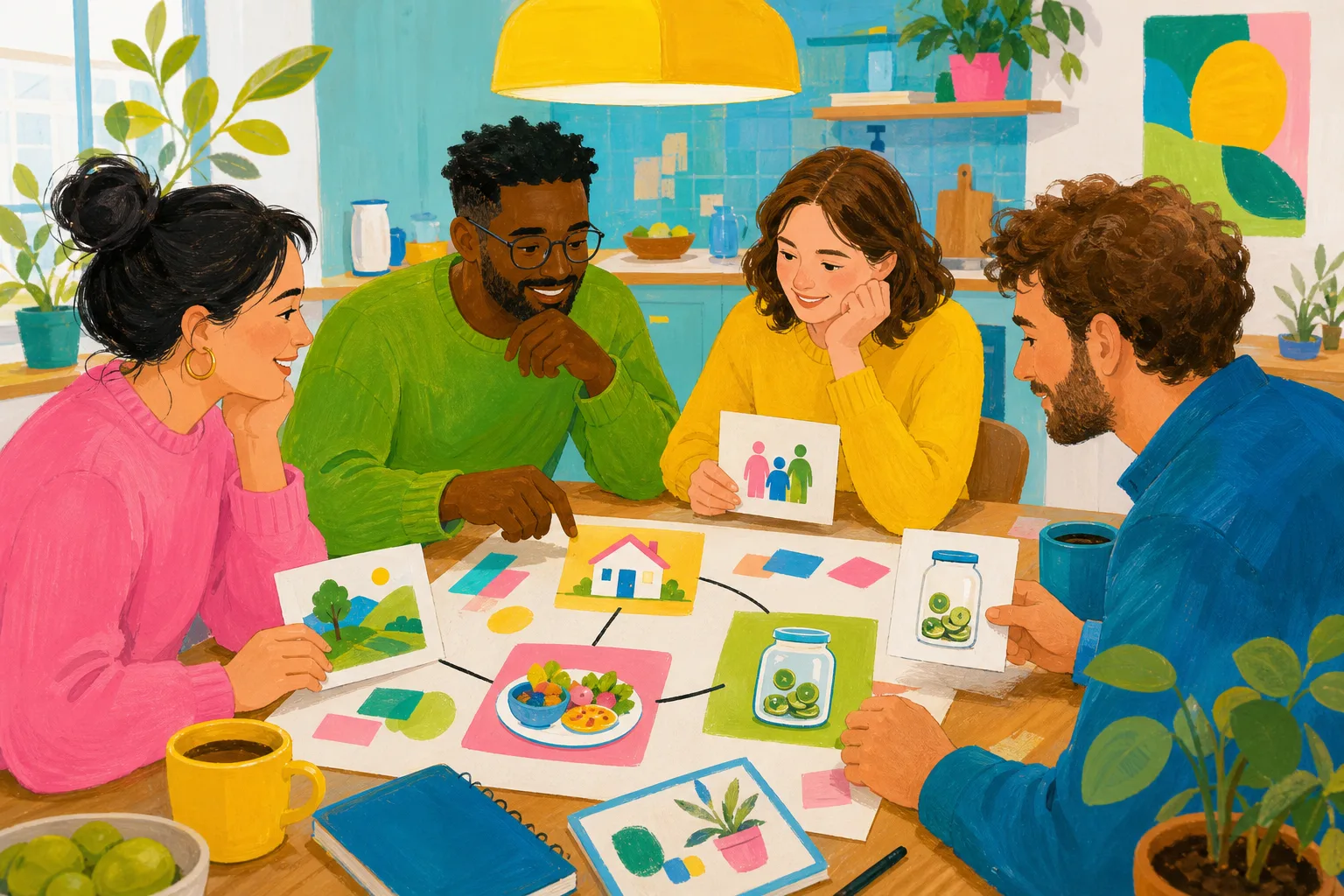
My own hopes are pretty straightforward. I want a fantastic family life with my wife, my stepdaughter and, yes, my poodle. I want our home life to keep getting a little better. I want our finances to improve over time. Those things give me energy because they are things I genuinely value.
What matters to you may be completely different. My brother loves going to Armageddon, the New Zealand version of Comic-Con, dressing up as characters and being part of that world. It does not particularly pull me in, but it means something to him. That is the point.
You do not need permission from the internet, your family, your old teachers or some imaginary panel of judges to value something. If it is meaningful to you and it helps you build a life you want to be in, that is worth paying attention to.
Make hope practical, not vague
I have done versions of goal setting for years. I look at where I am, what has changed and what I would like next. But I had not quite seen it as actively creating hope and meaning on purpose.
A simple way to start is to pick one area of your life and describe a before and after. Keep it grounded. Maybe it is, “I want to feel less stressed about money,” “I want more calm evenings with my family,” or “I want to make steady progress on a piece of work that matters to me.”
Then ask what one small move towards that after-version could look like this week. It might be a conversation, an hour set aside, a list, a walk, a budget check or simply writing down what you actually want. You do not have to solve your entire existence by Tuesday afternoon.
If your neurodivergent brain has a habit of trying to make every goal huge, urgent and all-or-nothing, smaller can be smarter. I have noticed that when I play too small because I am scared of losing what I have built, I can drift into chasing short-term relief instead. Food, alcohol, novelty or whatever gives a quick hit can start filling the gap.
ADHD can make that pull towards novelty and dopamine feel especially loud. I am still figuring out my own relationship with it, but I do think having something meaningful ahead of me makes it easier to notice when I am just reaching for a momentary escape.
If your next step is less about a huge goal and more about showing up gently, read how I think about consistency with a neurodivergent brain.
Build a life that gives you energy back
This idea has also made me think about the podcast. I realised I had been looking for topics I thought people would want, rather than talking more about the things I genuinely care about and am learning. That is not a great recipe for energy.
When I speak from a real place of interest, I have more to say. I care more. I can actually bring something useful rather than trying to guess what will perform well.
That may be worth looking at in your own life too. Where are you doing something because you think you should, but it leaves you flat? And where do you feel a little more alive, curious or engaged, even if it is not the obvious path?
You do not need to throw your whole life in the air to answer that question. Just notice it. Meaning often becomes clearer when we stop spending so much energy on what does not matter to us.
If the heaviness you are feeling is exhaustion rather than a lack of ambition, it may help to explore why everyday life can create burnout for dyslexic and ADHD adults.
For more of my personal perspective on these patterns, you can also check out Dyslexia and ADHD Explained From the Inside.
If this article has brought up familiar traits and you are still making sense of them, try the free adult dyslexia quiz as an educational starting point.
Choose one hope to carry forward
If life feels heavy right now, I am not going to tell you there is a single answer that suddenly makes it all make sense. But I do think there is something powerful in remembering that struggle is not proof you are failing at life. Everyone is carrying something.
My useful next step is to ask: what do I want to be hopeful for? Not what should I want. Not what would look best from the outside. What genuinely matters to me?
Pick one before-and-after you can care about, then take one small step towards it. That is not meaningless. That is you creating meaning in a way that fits your actual life.
Read the full episode transcript
Hey everybody, Stephen here from the Truth About Dyslexia. In today's podcast, I'm going to be talking about an experience I had going along to see Mark Manson speak, and there was a core topic that really jumped out at me around this idea of everybody being in the same boat and the meaning of life and how to kind of give yourself energy to keep going when you feel you can't. Really connected with me. I wanted to share it today, so let's dive into the episode. Okay, let's dive into this episode, guys. I am going to start, just before I do, I'm going to start to do more of these episodes about things that I'm really passionate about.
I think for a while I've been trying to pander to what I think people want to hear, and I think I've even said this a couple of times as I say it. But I find myself looking for topics I think people will love, and it's actually not my passion. It's not what I'm good at. I don't have the energy around those topics, and so I don't get across what I need to, and this led me to think about what I do with the podcast next year. Instead, what I'm going to do is I'm just going to start talking about what I care about, what I think is amazing, and what I'm learning, and that's giving me energy at the moment. And so for today's podcast, I was very lucky to go along and see Mark Manson speak.
Now, if you don't know who Mark Manson is, he wrote the Subtle Art of Not Giving a Fuck probably nine years ago, ten years ago now. It was an orange cover, had the F word on it. It was the reason I bought it at the time. You know, I like to sometimes look at things a bit differently, and in this case I did, and I really loved it. It was one of those books where I remember where I first started reading it. I was next to the ocean, sitting under a tree on a deck chair, like a camping chair, and I just always remember this feeling of going, I get what this guy is saying.
This isn't like every other self-help book. And, you know, 10, 20 years ago, self-help books were a lot more rah-rah, you can have everything, the world is your oyster, blah, blah, blah. Nowadays, they seem to be a bit more nuanced into different ways. And Mark, having admitted he was diagnosed with ADHD at 15, really helped me connect with what he was trying to say, and really, yeah, been really beneficial. He came out with another book. I can't remember if I read it at the time.
You know, if you're like me, sometimes books go in one ear and out the other ear, kind of story of my life. And you just remember feelings and maybe three or four core concepts if you're lucky, and if they've hit you at the right time. And I kind of forgot about it. I kind of went, ah, that was a good book, if anyone mentioned it. And then about a year ago, I started listening to his podcast, which is a really good listen, by the way. Him and Drew do a good job, and he's interviewed some really intriguing guests.
And so from there, when I heard he was coming to little old New Zealand, I was like, I'm keen. And for the first time ever, I managed to buy a VIP ticket, which means I could actually go and meet him after the event. Now, New Zealand, Auckland especially, has a population of about a million people. We're not a large country over in New Zealand. You know, we punch above our weight in a lot of things, but we're pretty small. So I had no idea how big this was going to be, how many people would be seeing Mark.
Like in many countries, I presume it would have been a line, there'd been signing, T-shirts, you know, blah, blah, blah, all the usual stuff. But we were so lucky that only six of us went back for the VIP meet and greet, which is a pretty small number of people for that type of thing. And even better than that, the other four people, bar me and my friend, were in a rush to leave and go and do something. So they got a signed book, shook his hand, a photo, and on they went. And so it was a really interesting, it was a really interesting experience, I must say. Like, we managed to get there and to sit with Mark for, I want to say two hours.
Well, not, sorry, not two hours. The event was for two hours. We sat with him for about 20 minutes just talking and just having a good conversation. Got to pick his brain. I got to share some ideas about dyslexia with him. Hopefully I dropped a few good nuggets he may use that could go out to more people.
He was a pretty brilliant person and just a real humble guy. And it got me thinking about some of the lessons I've learned from him and what I took away from the talk. And there's quite a few, so I will come back and do a few more podcasts on this. But for the sake of today, there was one key theory that really got to me, and it's this idea that everybody is screwed. Everybody is effed, is the way he would say it. Everybody has these challenges.
We're all going through the same massive world of problems. I'm sure you'd agree that, you know, there's no one you meet that you just go, That person has it perfect. You know, I used to probably, the people I thought were perfect early on in my life were those people that were really calm and just everyone liked them. They just really seemed to have a great balance of being present, where I sometimes got stuck in the future a lot or I was really self-conscious. It was those people that just never seemed conscious of what other people thought of them, and they were present. And it's kind of like they were the opposite of dyslexia and ADHD.
To me, it seemed so simple for these people, you know, and those were the ones that I'd kind of look at on that tangent. But realistically, even them, everybody's having problems. Everyone's having these internal dialogues to different degrees. I'm sure our dyslexic ADHD population are a bit higher than many in this case. I can guarantee that from the way my mind works. But, you know, the key with this is this realization everyone's having problems.
I've talked about this with the idea of whenever somebody's pointing one finger at you, they've got three fingers pointing back at themselves. Most of us are talking to our own problems, not to what we think of other people. It's very rare. You know, most people are just reflecting or putting into whatever conversation their own shit. You know, it's just how the world works. And, like, that realization helped me five or six years ago.
I had a massive aha moment when I was going through some challenges, and that really got me through it. And for so long now, I haven't really applied that thinking, that realization. And so I started, you know, bringing me back to this book. So I have this signed book. When you get a signed book, it kind of gives you a little bit of energy to actually read it. So I started reading the first chapter this morning.
You know, I've been lucky that I've actually had a quiet weekend where I have had no responsibilities. It's been absolutely lovely. I can't speak highly enough about making sure you have some of those. But I actually got up and spent an hour reading this book. I actually make reading look really tough and slowly read it, and I even saw my ADHD focus go off into a few directions as I did it. But what was really good about this first chapter, it really spoke to this.
It spoke to this idea that everybody,and this will get better after I say the first bit,but everyone's lives are meaningless. You know, it sounds crazy, right? But the way Mark places this, he goes, everyone's life are completely meaningless. We are a speck of dust in this huge cosmic world, and that, you know, you imagine when you die, no one's going to remember you. Even the people we really remember, we only slightly remember them. We don't think about them every day, nine times out of ten, right?
You know, majority, and we're talking majority here, the people that we're talking to on this podcast, is that all of us, including myself, we're here for a period of time. We get a great opportunity to do what we want, but all in all, we over, we, what do they call it? We over-grandize ourselves. We think we're much more important than we are. We're like the leader of our own stories, right? And so we think there's some massive purpose for our life, and without that, there's nothing.
Like, and we have to think like this. And the way he places it is, he goes, and one of the things that stood out to me really well around this was when he said, What is the opposite of happiness? And I was like, Oh, anger or sadness. And he goes, Actually, it's hopelessness. Hopelessness is the opposite of happiness. And I found, I stood back for a minute and said, Okay, it kind of makes sense.
And he goes, You know, if you're angry or you're sad, you still have hope. You've got something to hope for that makes you angry or sad. But if you're hopeless, you have no emotion, you have no drive, you have nothing. So hope is what fuels everything. So if you start to put these pieces together, you've got this meaningless existence, which sounds terrible when you think about it that way. I recommend his book, Everything Is Fucked: A Book of Hope, because this is how it starts.
But it talks about this meaningless world, but this absolute need for hope, because it's the only thing that drives happiness. And so if you imagine, okay, you've got a blank playing field. Every one of us has a blank playing field. Many of us have a lot of baggage and stuff we bring along into that playing field, but when we can realize that playing field can be emptied at any moment. You just keep what you want. It's pretty empowering, right?
And when you realize that you've got this engine of hope that you can create, like some people use religion to create that hope. It's a fantastic tool for many people. It's been a great hope driver. Some people have politics; they make their hope driver. Some have business. You look at the Steve Jobs, these people have done amazing things there.
Like, they had a real hope driver there that was driving them to where they want to be. And so, you know, when you start to pull all these pieces apart, you can start to say, okay, why am I wasting my energy or time on all this stuff that doesn't matter? And how can I put it into stuff that does matter? How can I choose what gives me hope, my story, my before and after story? You know, and like I've done this personally every year, I kind of look at where am I now? What do I want?
What have I achieved? It's kind of the basis of that whole goal-setting process. But I don't think I've ever looked at it quite like this, is that this is, I'm choosing what I'm hopeful for. I'm creating meaning on a yearly basis. That's kind of my way of doing it. Some people have lifetimes.
It's a lot harder, it seems, lifetimes meaning. But again, it's this realization that you have complete control over creating the meaning in your life. It is not external of you. It is not something that's going to magically hit you in a blinding moment. This is something that you're going to create. You're going to experience something, and you're going to come into it and go, hey, I am here.
I want to be there. That journey is the meaning. That journey is the hope. And so on that, like it just, it really grabbed me. It's really captured my thinking about going, okay. Like, I don't need to worry as much about all this other stuff that doesn't matter.
None of it matters. I just get to matter about whatever I hope for. Like, I hope to have a fantastic family life with my wife, my stepdaughter, and my poodle. You know, sounds weird when I say poodle out loud, but I do love the dog. The, you know, we've got a, you know, that's kind of something I hope for. I hope that every day gets a little bit better, and I can contribute to that, and I'm part of it, and my family life gets better.
That's my hope. You know, I hope that our financial situation keeps improving a little bit each year. It doesn't have to be massive. It's not like a life meaningful driver, but I hope that that works. And if I see that working, it gives me a bit more energy. So family, my home, my finances, and then when it comes to work and what I'm doing with this podcast and all this stuff, I need to take more time to build what that hope looks like.
I've kind of reached those before and after stories repeatedly, and it's great. And I haven't really set massive hope kind of goals, I guess what I'd call them, or before and afters, but I'm going to start to. I'm going to start to kind of give it a go, start to add a bit more deep meaning to my life that kind of drives me. Because I think when you don't have enough, like it can be very easy to, some people call it playing small. It's so easy to play small with your hope because you're less likely to fail. And I've definitely done that to a point.
I've played quite small because I don't want to lose what I've built or what I have because I love it. And so, but when you play small, I think you can sometimes fall into a bit of nihilism where, you know, I've definitely had this happen to me over time where I'm just looking for pleasures, like be it alcohol, be it drink, you know, drinking alcohol, same thing, be it food or whatever it is that You know, gives you a momentary relief. You know, ADHD especially pushes us towards that, the dopamine drive. You know, it's like we're already set up to be slightly more nihilistic than others because our brain is desperate for novelty and this side of things. So maybe we're just naturally more nihilistic. I don't know.
Is nihilistic a word? Who knows, but it sounds like it could be. I guess all these thoughts are just to get you thinking about if you're struggling with meaning in your life, you know, you can create your own meaning. Why not? Like, what's there to lose? All it is is creating something that's before and after that you want to achieve, that you put value in.
No one else can tell you what to value. You know, you might value, like my brother values going to Armageddon and dressing up like people. Armageddon's like Comic-Con over in the States where people like to dress up like characters and go along and enjoy it. My brother loves that. He has meaning in that. He's created hope in that.
To me, it means nothing to me, but to him, it means everything. And so this meaning is all self-driven. And when you can self-drive and control it, that really helps with a lot of our issues of control. You know, for many people listening to this podcast, we'd all say we have some, like, control challenges. So, yeah, hopefully this has given you something to think about. I do recommend Mark Manson's book.
I'm getting through it again now. It's really great, and I will come back with a few more tips from that meeting over the next few weeks because I want to embed it in my own brain, so me talking about it helps that process. So hopefully you've enjoyed this podcast. Have an epic rest of your day, and I'll be back next week. Thanks for listening to the Truth About Dyslexia. This podcast is sponsored by Added Nutrition and our new product, Added Sleep.
It's designed for brains wired differently. If you want to sleep better, maybe give it a try. Use the code Truth About Dyslexia to get a $10 credit on your order at addednutrition. com. Link in the show notes.
Recognise some of this?
Take the free quizSee which adult dyslexia traits feel familiar.
This short quiz is educational and gives you a useful next step.
Keep exploring this topic

Useful reading and listening for your next step.
Read next
Listen next