Truth About Dyslexia podcast
Finding Purpose With a Neurodivergent Brain: It Can Change With You
Purpose does not have to be one massive answer you find once and follow forever. I share why I now see it as something that shifts with your health, work, relationships and ability to be present.

Listen to this episode
Finding Purpose With a Neurodivergent Brain: It Can Change With You
Open this episode in Spotify

Follow the podcast and keep the next episode close.
What you will take from this episode
- Purpose can be a direction that changes as your life changes, rather than one fixed destination.
- Big changes, disappointments and difficult periods can create space to notice what no longer fits.
- For a neurodivergent brain, the push to grow can make it hard to slow down and simply be present.
- Small moments of peace, happiness and gratitude can be a more useful measure than an external target.
- You do not need to use someone else’s definition of purpose.
When slowing down makes the big questions louder
Have you ever been forced to stop, then suddenly found your brain asking questions it had been too busy to ask? What am I doing? Is this working? Am I getting closer to the life I actually want, or am I just spinning my wheels?
I’ve recently had a nose operation to help me breathe better at night. It definitely was not a bid for a George Clooney nose, despite the jokes. The recovery meant resting properly, sitting still and letting my body heal, which is a challenging ask when you’ve got an ADHD-style brain that likes lots of channels running at once.
At first it was confronting. Then, oddly, it was a relief. For once, I had one job: heal. I didn’t have to think about work or try to solve the next ten things at the same time.
That quiet gave me room to think about purpose. Not in a grand, “I’ve solved life” kind of way. More in a, “What does this word even mean to me now?” kind of way. If you’re trying to make sense of finding purpose with a neurodivergent brain, you may know exactly what I mean.
Purpose often starts as someone else’s idea
When we’re young, purpose can be very external. It comes from what our family values, what our friends are doing, what we see on television, or the paths that seem normal around us. Maybe it is becoming a doctor, going into the trades, getting married, starting a family or chasing a particular career.
There is nothing inherently wrong with taking those cues. We all start somewhere. But at some point, we can realise we are following a script that does not quite fit anymore.
For me, one of those moments came in my mid-twenties. I left the insurance industry and moved into web and digital work. I did not have some perfect master plan. It was more of a work crisis, a breakdown point that made me reconsider what I was doing.
Over the following 15 years, I’ve built towards work I genuinely like and feel proud of. I’m not done, and I don’t think any of us are ever really done. But that earlier disruption helped me move in a direction that felt more like me.
If work and big ideas are taking all your mental bandwidth, you may also relate to my thoughts on solving business problems without burning out.
A hard reset can reveal what no longer fits
I think difficult events can sometimes bring self-awareness to the surface. A breakup, an injury, redundancy or another kind of shock can make you ask: who am I now, and what do I want to rebuild? That does not make the hard thing good. It just means we may be able to learn something from it over time.
I’ve had that in relationships. In my first marriage, I had a confronting realisation that we had got together at a time that matched us both, but we were not the right people for each other. We tried to make it work, but the relationship ended. It was painful, and it was also the right thing.
That period made me reset parts of myself. I got fitter. I grew a beard, which I still consider a solid decision. More importantly, I started looking more honestly at who I was and what I needed.
Later, I spent years trying to become the person I thought a partner wanted. I had low self-esteem and was trying to win the relationship, often at my own expense. That can work for a while on the surface, but it does not tend to hold up long term.
The awareness did not arrive neatly or quickly. But coming out the other side helped clarify the kind of relationship I wanted. My family life with Holly is now a part of my life that feels right. Purpose, in that sense, was not a single answer. It was something I understood better after paying attention to what did not fit.
If relationships are part of what you are trying to understand, 20 Things to Remember if You Love Someone With Dyslexia may be a useful place to start.
Purpose is a direction, not one job for life
The word “purpose” can be especially hard to get your head around when you are dyslexic or a strong visual thinker. It is not a physical thing. It can feel vague, loaded and strangely slippery. One person’s purpose might be another person’s distraction.
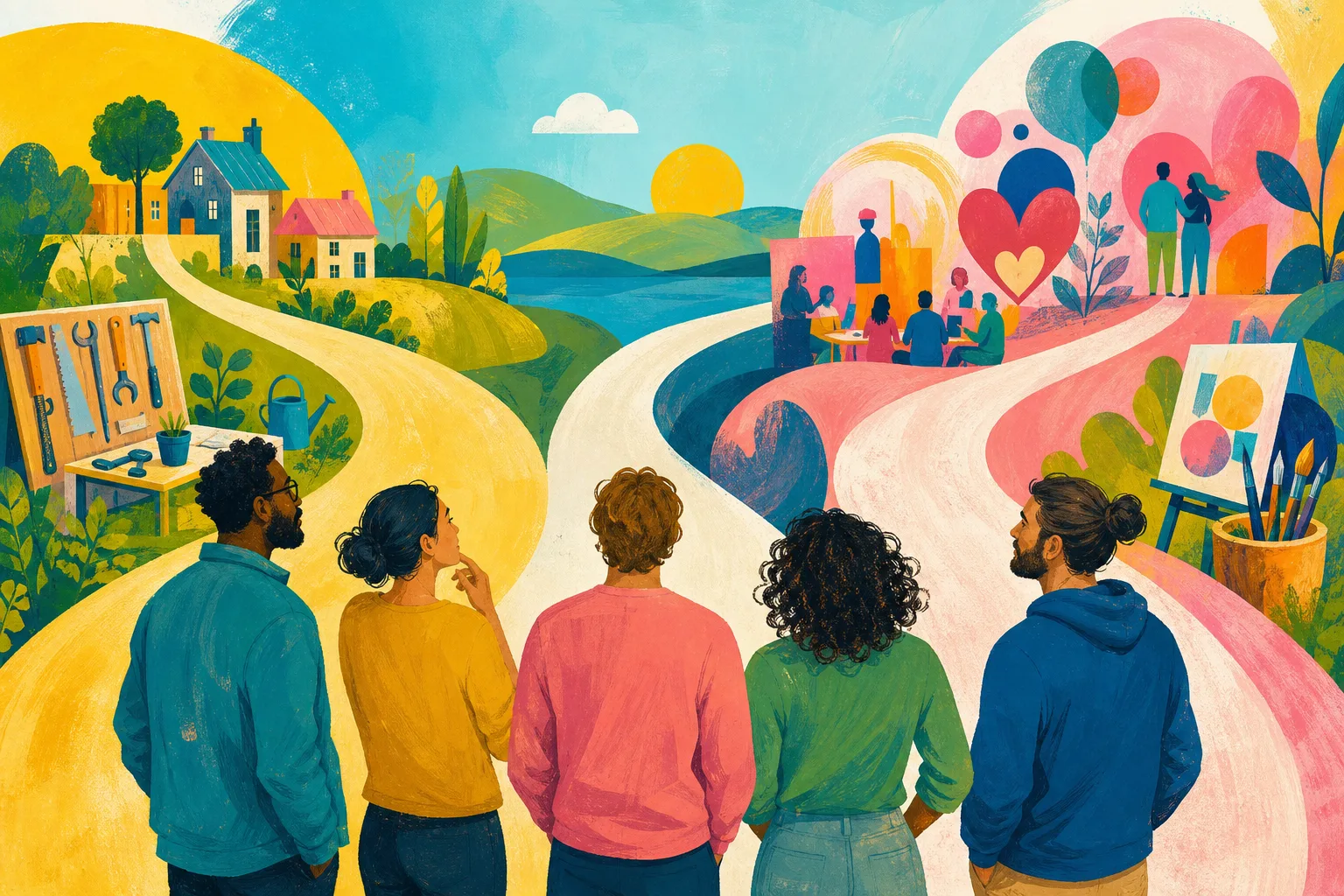
So I find it more helpful to see purpose as direction. It is an active thing, and it can change. You may have a health direction for a period of life, then a work direction, a relationship direction or a family direction. A few of them may be happening at the same time.
I have seen this in other people too. Someone can be made redundant later in life, change industries and discover they love doing practical work that helps people. It might not make them millions, but it pays the rent and gives them a life they enjoy. That is not a lesser purpose because it does not sound impressive at a dinner party.
This matters for adult dyslexia and ADHD because many of us are highly growth-oriented. We want to improve things, start things, solve things and become a little better. That drive can be brilliant, but it can also make us feel as though we must always be moving towards the next milestone.
I share more of the inside view of these patterns in Dyslexia and ADHD Explained From the Inside.
Growth and presence do not always feel compatible
One thing I am still working on is the tension between growth and presence. There are times when I become a full-on growth machine. I enjoy that part of myself. I do not want to erase it or pretend it is bad.
But it is hard to be endlessly focused on improving your future while also completely present with your life as it is. Presence asks you to notice that you are enough in this moment. A growth mindset can keep pointing at the next thing to fix, build or achieve.
Meditation helps bring me back to myself, although it works better at some times than others. Before recording this episode, I had a moment in meditation where I felt present and peaceful. Nothing had to change for me to be me. Those moments can feel far apart with dyslexia or ADHD in the mix, which is exactly why I think they are worth noticing when they arrive.
This is not about forcing yourself to be calm, grateful or content every second. That would just become another impossible task to optimise. It is about spotting a small moment of peace, taking a couple of deep breaths and letting it count.
If your energy, attention and intentions seem to shift constantly, you might find how I stay consistent when my neurodivergent energy is all over the place helpful.

Try a smaller definition of purpose
We are often sold the idea that purpose is a huge external goal. Build the business. Hit the number. Work hard until retirement, then finally get to be free. I do not buy that idea as much as I used to.
Waiting until some future age or achievement to let yourself be who you are feels like a bad deal. Life is happening while we are waiting.
At this point, my own purpose feels much closer to finding moments of happiness throughout the day: in pain, pleasure, growth, mistakes and ordinary life. I want to share those moments with other people where I can. There is no specific number attached to that and no finish line.
The things around the edges still matter. Getting healthier, strengthening my relationship, doing meaningful work and making my environment more comfortable all support that goal. But they are supports, not the whole point.
If you are not sure whether dyslexia may be part of how you experience self-esteem, overwhelm or direction, try the free adult dyslexia quiz.
For more honest conversations about dyslexia in adults, ADHD and the sometimes messy process of understanding yourself, explore the adult dyslexia podcast.
Your purpose gets to be yours
I do not think you need to discover one perfect sentence that explains your entire life. Purpose may evolve after a hard season, become clearer through a relationship, change with your health, or show up quietly in a few good minutes of an ordinary day.
Have a think about the meaning you give the word. Is it something you actually want, or something you absorbed from everyone else? Then look for one small way to make room for a moment of peace, enjoyment or honesty today. That might be a much more useful next step than trying to solve your whole future before lunch.
Read the full episode transcript
Hey everybody, Stephen here from the Truth About Dyslexia. In today's episode, I want to talk a little bit about purpose, finding your purpose, what does it look like, and some of the challenges I'm struggling with at the moment around this, because I think it could help some people who need to hear it. So let's dive into today's podcast. Okay, so I've been away for a couple of weeks. I've had some recorded pods going out, which has been fantastic. And what I went and had done was I went and had a nose job.
Now, if you'd have told me that's what I'd have done at the beginning of this year, I would have laughed quite a lot. Now, this wasn't a nose job to make me prettier. It wasn't a George Clooney nose, as I joke with my friends and family, but it was so that I could breathe better at night. I've had a little bit of sleep apnea as I've been going, and this has opened up my airways. And I'm currently in the healing process, which, if you've got ADHD, you know, trying to actually sit still and let yourself heal is potentially one of the hardest things you can ever do in life, and it's very confronting. You know, being, I literally had a week where I rested and bed.
I think I got through half of the Big Bang Theory. I was, you know, I couldn't sleep on my side. I had to sleep sitting up for four days, five days at least, maybe even longer actually. And it was really tough. You know, I got into it over a few days and really enjoyed it because it was the first time I'd actually had a break in ages where I didn't have to think about work. I had to put myself first, and I had to do one thing, which was heal.
And I feel like in life, I'm not sure if it's the same for you guys, there's always so much on. There's always so, I've probably taken on, I take on too many things. You know, even though I know I do it, I still do it. It's just kind of how my brain works. It's how I like to operate. I like to have a bunch of channels going at the same time.
But being forced to not have that was also absolutely fantastic. And, you know, when you have an operation, you're very, very conscious of what is happening at that exact moment. You're very, very conscious because, like, if you think about your nose, for example, you don't feel your nose at all. Like, you don't think about it. Maybe you scratch it from time to time, but it's just there. When you have an operation, which changes how it works, your body is like, What is this thing on your face?
What has happened? And it's kind of conscious of it all the time. It feels kind of fresh. It feels raw. It feels new. It feels different.
Your brain is trying to reconnect. Why can I breathe through this so much better than I used to? How does this work? It's like having to relearn the nose algorithm of your body. And so, you know, it's really interesting. You know, I find myself like I need like a cone around my neck so I don't touch it all the time because it's so weird and different, and like it's noticeably different to me.
Others notice a little bit, but for me, it's very noticeable. And what it got me doing near the end of my resting period was I had a lot of time to think, as you can imagine. And a lot of that was on, you know, I started to go down this track of, you know, what am I doing? What do I want to be doing? Am I getting closer to where I want to be, or am I just spinning my wheels? And this question, oddly, has come up a lot on podcasts I've been listening to around purpose.
You know, I'm a big fan of the Tim Ferriss podcast, a big fan of Stephen Bartlett, and they've both had guests on talking about finding your purpose. And I thought it would be a great thing for me to share some thoughts on it and some of the learnings I'm getting from these podcasts. You know, one of them was Stephen Bartlett spoke to Dr. K. He's an Indian American doctor, really nice guy. You know, brilliant thinker, very fast thinker.
And what I really liked about his take on purpose was when you're really young, your purpose is very external. It's what your family, what your friends, what people around you, you know, talk about, what they want, what you see on television. You know, some families may make you want to be a doctor or a lawyer or, you know, other families have always been builders. Maybe you want to get into the trades and build like your father. And, you know, your purpose starts to become very externalized. It's very what is around you, what are you seeing, you know, what are other people doing?
Are they growing up and getting married? Are they, you know, having families? Whatever that is becomes your purpose, and you kind of tag along to that. And then over time, what happens is at some point, usually when there's a trauma, maybe it's a breakup, maybe you injure yourself, could be any trauma, you start to, you know, you start to learn. And if you have a bit of a breakthrough in self-awareness, you can start to say, okay, who am I now? What do I want to try and rebuild to, and what do I need to become?
What has to break down to grow? And it's kind of, it's usually that whole three steps forward, two steps back kind of principle. And I really connected with this because, you know, I think back to my first marriage. I think back to, you know, when I started out at work, I didn't really know what I was doing. You know, I probably had my work crisis at about 24, 25, where I left the insurance industry and I got into the whole web and digital space. And then over the last 15 years, I've kind of built myself to where I really like and what I'm really proud of.
Still a long way to go. I don't think I'll ever be done. You know, I don't think there is such a thing as being done. But it's, it's, it was a real kind of breakdown moment. I was quite lucky to have that quite young. People have these moments, like I've seen someone who would be 58, got made redundant.
You know, they thought they were doing great with their work and then swapped industries and became a home handyman. And he loves going out and helping people with little projects. They change, they're interesting, just loves his little business now. Doesn't make millions of dollars, but pays the rent, keeps him doing what he loves, and just really enjoys it. And he had to have that breakdown or that trauma even later in life to get to what he wanted to be doing, which is pretty funky and pretty cool. So I had that with work.
I then, when it came to relationships with my ex-wife, you know, I always remember going away to this business conference over in Australia, being based in New Zealand. It's pretty close, about a three, four-hour flight. And I met a girl there and I was chatting to her, and I could have deeper and more meaningful conversations with this girl. It wasn't anything dodgy or anything, but I could have better conversations with her than I could my own wife. And when I got back to New Zealand, we had this conversation, and it was kind of this awareness that we both kind of got together at the right time, you know, the time that kind of matched both of us, but we were the wrong people. That was really confronting.
It was really direct, interesting. And I kind of, I found it, you know, I said that to her and we said, Oh, let's try and make it work. Gave it a month, and in a month later, she ended up ending the relationship, which was in all essence the right thing to do. We weren't right. You know, it was hard at the time, but it needed to be done. And in that moment, again, that trauma allowed me to start to rebuild myself.
I got fitter. I decided to grow a beard, which was a good decision in my opinion. And, you know, I had this purposeful moment of going, Okay. I need to reset a bit of my who I am. So that moment actually helped me really help my health, oddly, over my relationships. I went on and had another relationship that didn't quite work out for four or five years.
It was good, you know, she was a lovely person, but again, the wrong person. I hadn't really dealt with who I was and what I wanted, and what my purpose... And I think this is the thing: purpose can be, is a doing word. It's a thing that's an actionable thing. It's not like you have one purpose and you will do that until you die. It's something that changes, that evolves.
You know, you can, I believe, have different purposes for your journey in health. It's all these different journeys. And I think, you know, being dyslexic, you know, purpose is a real hard word to get your head around because it's not a physical word. It's a trigger word. It means what you put meaning to it. And so, like, that can be so different for people, and they can be listening to podcasts and all this stuff and not really get it.
And so for me, like, it's that direction. And so, like, I got my health direction at that point really helped me. But it took me another whole relationship to realize I was going through a lot of challenges, and I was trying... I got into this point in life where I was, you know, I had low self-esteem, like many neurodiverse kids did, or people, and I was trying to win my relationship. I'd found someone who I liked, and I wanted to win them as my girlfriend or my partner. And I did.
I did. I became the person she wanted, and at an expense of myself to a point. And, you know, let's be honest, that never works out long term. We all kind of can get that. Doesn't stop us as humans doing it. And people can do it for way too long.
I did it for, as I say, four or five years. And once I got out the other end of it, I really could see what I'd done. I was very lucky that awareness kind of hit me, and the purpose of the relationship I wanted became more clear. And I was lucky to find Holly, and, you know, when married, we were fantastic. It's worked out. My family purpose part is great.
And, you know, what this, you know, being ill,not ill is the wrong word,being, you know, being under the weather from the surgery and having to actually recuperate gave me time to reflect on a lot of the stuff and go, you know, we all have these different multiple purposes that are all happening simultaneously. It's not just one thing that we're hunting. It's about what is this thing that we're, you know, what are these different parts of our life and how are we growing into them? And I think this is the key with neurodiversity, is many of us are growth orientated. Many of us want to be a little bit better. We struggle to sit and just be in the moment, which to me is the hardest thing.
I go through patches of life where I can get quiet in the moment, and then I go through like a year where it's like I become this growth machine, because you can't be a growth machine and completely present. They don't fit. Completely present is being aware and happy with your current lot in life and, you know, just being with what is and realizing you are enough and all of that, which is a truth which I truly believe. Whether I can be with myself in a quiet moment like that, it's really tough. It's not how my brain operates a lot of the time. It's why I use meditation to bring me back to it, but sometimes it works more than others.
And so I guess where am I going with this podcast is I think the key with purpose and what I've realized is, you know, finding gratitude in the moment, in the day, and trying to keep this balance between the growth side of me that I know I love and care about, and it's me, and I love who I am there. I don't want to change that. I love that part of who I am. But also finding time to truly give myself moments where I get to be who I want to be. I kind of thought about it the other day as kind of it's like retirement. You know, people say, Oh, I'll retire at 65.
I'll work hard and then retire at 65, and then I'll sit there and I'll just be who I am, and I'll just be able to be, you know, I'll be free, which is just a lie, right? It's a lie people say to ourselves to, you know, pretend like something's going to switch at that age and everything will become easy and I'll just do fun things, which is just, you know, ridiculous, really. You know, it's something that we got sold. Whereas realistically, what I'm trying to do more and more now around my purpose is take time to just, like, be who I am. And my purpose, like I think majority of people's, is to find happiness in every, you know, every moment, in pain, in pleasure, in growth, in, you know, realizing you've grown the wrong way or something isn't right. It's to find those moments of peace throughout every single day that just make me happy.
It's not like some big external thing I have to have or have to build. You know, those will come and go for the rest of my life. I will have different, I kind of call them follies rather than purpose. We're lucky to get someone go, my purpose is to build a million-dollar business or ten-million-dollar business or da da da da. It's like, it's great, you know, that's a great distraction. But, like, my purpose is to find those moments of happiness and hopefully share that with more other people so that they can find them as well.
And there is no number of people, there's no goal, there's no target. It's about finding that place for myself, and I feel I'll be doing that for the rest of my life because it's really hard. It's not easy. It's not like you get to a point and you're done. It's, you know, I had a moment before when I was meditating before this podcast where I felt really in the moment. I felt present.
I felt nothing else had to change for me to be me. And that's absolutely beautiful. And with a neurodiverse mind, with dyslexia or ADHD, those moments, they can be far apart. And so you've got to really be grateful when you have them, and have a couple of deep breaths and be thankful. Be grateful for those moments because those are what we're all aiming for. We're kind of aiming for a way of building a life with more of those moments.
And for me, that's kind of the purpose of the whole thing. And everything I do around the edges is all towards that, be it becoming healthier, building my relationship up better, creating a more comfortable external environment, all helps me to get to that level. So this is what I want to share today, guys, around purpose. And I know it's a bit all over the place, but it's one of those topics where really reflect on how you see purpose in your life. What is your definition of purpose? Because I'm sure it's probably different to mine and a bunch of others.
But just remember, you know, it's all about how you see the world, not anyone else. Have an epic rest of your day. I've been Stephen from The Truth About Dyslexia. Thanks for listening to the Truth About Dyslexia. This podcast is sponsored by Added Nutrition and our new product, Added Sleep. It's designed for brains wired differently.
If you want to sleep better, maybe give it a try. Use the code Truth About Dyslexia to get a $10 credit on your order at addednutrition. com. Link in the show notes.
Recognise some of this?
Take the free quizSee which adult dyslexia traits feel familiar.
This short quiz is educational and gives you a useful next step.
Keep exploring this topic

Useful reading and listening for your next step.
Listen next