
Truth About Dyslexia podcast
Why ADHD Minds Can Feel Comfortable in Chaos
I share why chaos can feel oddly familiar when you have ADHD and dyslexia, how I think about the right amount of challenge, and why firm decisions can free up mental space.
Listen to this episode
Why ADHD Minds Can Feel Comfortable in Chaos
Open this episode in Spotify

Follow the podcast and keep the next episode close.
What you will take from this episode
- Chaos can feel familiar enough that slowing down is uncomfortable, even when being busy is exhausting.
- I find boredom and overcommitment can pull me into the same cycle: take on too much, burn out, then start again.
- A useful challenge is not necessarily massive. I aim for something that stretches me without throwing my whole life into panic mode.
- Making a firm decision can stop the same draining question from taking up space in your head.
- Gratitude does not remove real stress, but it helps me notice what is already solid and good in my life.
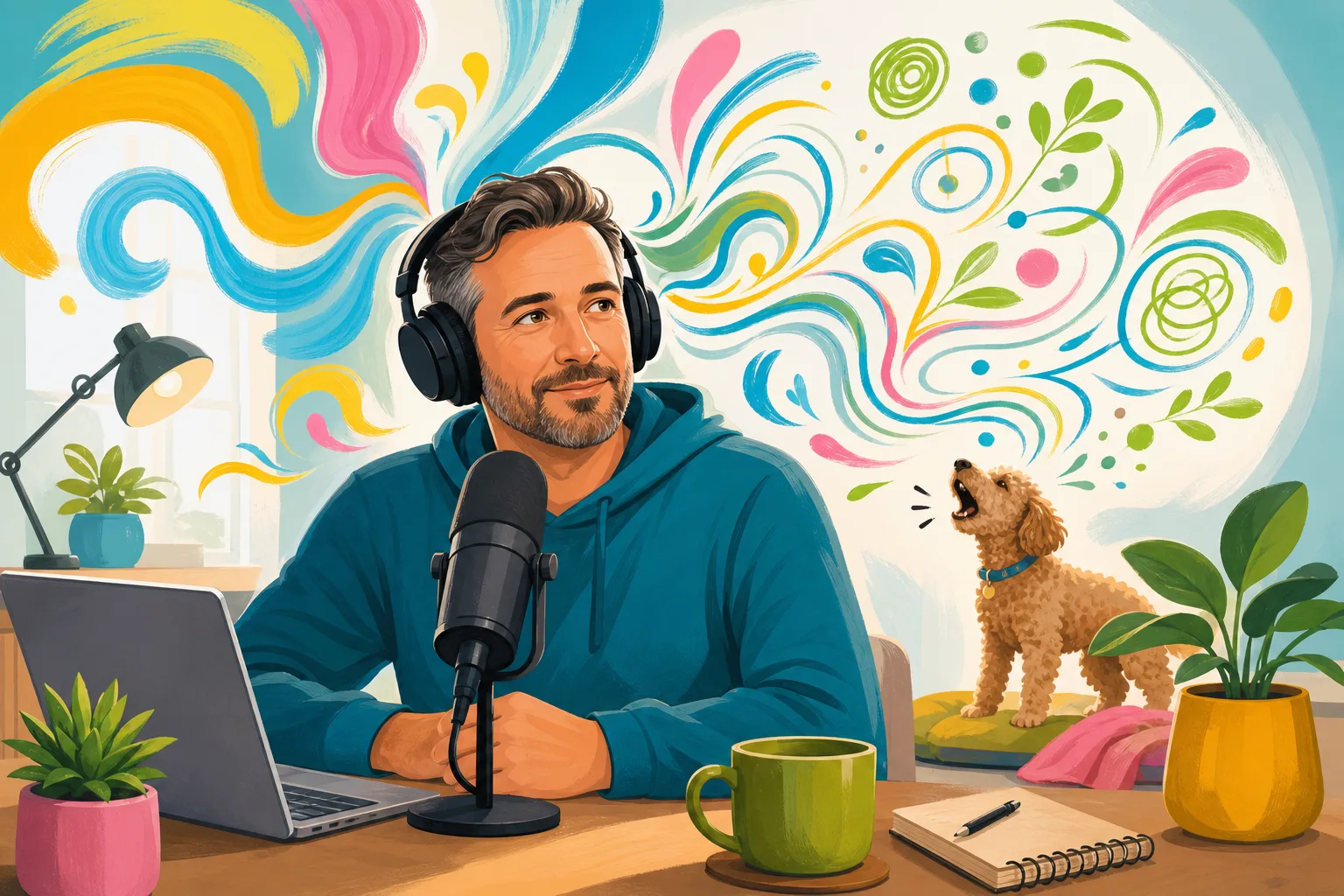
When a barking dog used to ruin the whole recording
There was a dog barking while I recorded this episode. A few years ago, that could have been enough for me to bin the recording and start all over again. One little imperfection, and my brain would have decided the whole thing was wrong.
That is a familiar pattern for me. Sometimes my mind gets incredibly granular, picking apart tiny details and getting worked up when I make a mistake. Other times, it goes completely big-picture and starts worrying about everything happening in my life, or everything that might happen months from now.
If you live with adult dyslexia, ADHD, or a mix of traits that makes your mind run in several directions at once, you may know that feeling. The noise is not always outside of us. A lot of the time, it is the constant commentary, possibilities and decisions inside our own heads.
Why ADHD minds can feel comfortable in chaos
The strange thing is that stress is not always unfamiliar. For me, chaos can feel oddly comfortable. I can be exhausted by having too much on, yet the idea of having nothing to do and being bored can feel worse.
I see a cycle in myself: I take on work, projects or goals because I need challenge and interest. Then I overcommit, get stressed, try to pull back, and before long I am committing to something else. It is not that I want my life to be hard. It is that a completely quiet, flat life does not suit me either.
That is why I do not think the answer is simply to slow down and make everything easy. I like challenge. I like building things. I like having something to focus on. The important bit is noticing when challenge has crossed into a level that is making my life smaller, more anxious and harder to enjoy.
The world also gives us endless ways to avoid sitting still. Screens, social media and an infinite stream of things to watch can fill every spare moment. I can absolutely see the appeal. But when I never leave room to be with my own thoughts, the pressure does not disappear. It often just waits for a quieter moment and comes back louder.
Stress, anxiety and the battle for attention
I can get anxious about the future very easily. My dyslexic mind can show me a huge range of possibilities, including all the bad ones. My ADHD side can then latch onto one of those possibilities, whether it is important or not, and give it far more attention than it deserves.
The thought may not be happening in real life, but it can still feel very real in the body. Add everyday pressures, money worries, work, relationships and the general noise of the world, and it is easy to see why so many people feel stretched.
What helps me is bringing my attention back to what is actually in front of me. Not in a perfect, never-worry-again way. More in a practical, ‘what is the next piece of work I need to do?’ way. When I am busy, I can waste a lot of energy imagining the next six months instead of putting my head down and doing today’s job.
I also practise gratitude most weeks. Sometimes it is simply remembering that I have a family, food on the table, a roof over my head and choices in my life. That does not make stress vanish, and it does not mean hard things are not hard. It just helps me remember that not every part of life is on fire.
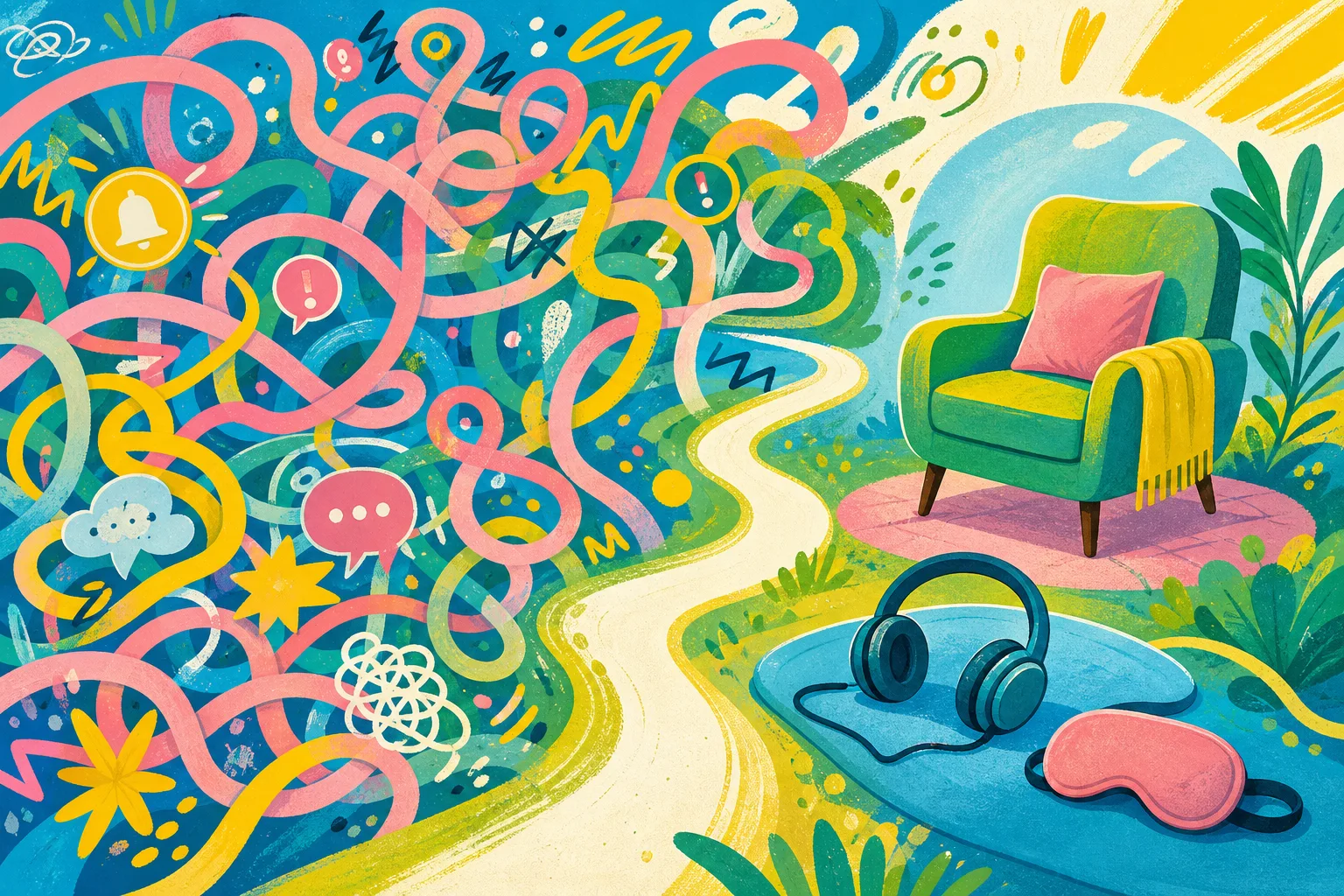
Finding the challenge that is just outside your comfort zone
A conversation I had with Dr Edward Hallowell has stayed with me for years. He described writing a book as being around 10 percent outside his comfort zone. His home, family, work and routines were still there, but the book gave him enough stretch to stay interested.
I love that idea because it is not about living in a permanent state of panic. It is also not about sitting in boredom. It is about knowing what makes up your solid base, then choosing something that pushes you just enough.
I have been trying to build my life around that. I have a home I love, a wife, a stepdaughter, a poodle that I never expected to love quite this much, and plenty of geeky automation around the house. I do not need to blow all of that up in pursuit of more stuff. What I want is security, plus a challenge that matters to me.
For me, getting my health and weight into a better place has been one of those challenges. I have been overweight for many years, and food has been an emotional crutch for me. I am trying different supports, including hypnosis and Havening, while accepting this is likely a longer process. The goal is not a dramatic overnight reinvention. It is building consistency around things I already know I want to do.
If you are wondering where your own line sits, ask yourself two questions: am I genuinely challenged, or am I just overloaded? And is this challenge helping me build the life I want, or pulling me away from it?
Making firm decisions to reduce mental clutter
One of the biggest things I am experimenting with is making firmer decisions. Not because every decision in life has to be permanent, but because some open loops cost me a ridiculous amount of mental energy.
Alcohol was a clear example for me. Over the past five years, I had periods of being sober, including eight months and around a year at different points. But I kept hovering around the question of whether I would drink again, give up for six months, give up for a year, or just have one. Every occasion became another internal negotiation.
I realised that leaving the question open was taking up RAM in my brain. I do not find the middle ground works well for me with alcohol, so I decided to try fully committing to being sober. At the time of recording, I had been doing that for about 10 days, and I felt good about having made a clear call. I can enjoy a sparkling water with lime and not spend the whole event having the same debate with myself.
Your version may have nothing to do with alcohol. It could be a project you keep saying yes to, a boundary you keep softening, or a goal you keep postponing. If a question returns every day and drains you every time, it may be worth asking whether a clear decision would give you some mental space back.
This is not about being harsh with yourself or pretending life is simple. It is about noticing where indecision is quietly creating more stress than the decision itself.

You do not have to choose between boredom and burnout
I am still working this out. I still overcommit. I still have times when I am more focused on my health than I am giving the attention I want to give my wife. I still look ahead, see a busy few months and feel the anxiety rising.
But I am getting better at pulling myself back. I do not need every opportunity. I do not need to turn every interesting idea into a massive commitment. I can have enough positive pressure to feel alive without creating the sort of chaos that leaves me wrecked.
If your brain feels most at home when everything is mad, start small. Notice one place where you are at 50 percent outside your comfort zone, when 10 percent would probably do. Then choose one next action that brings you back towards solid ground.
For more honest conversations around the messy overlap of dyslexia, ADHD and everyday life, you can explore the adult dyslexia podcast.
If you are trying to work out whether dyslexia traits might be part of your own picture, the free adult dyslexia quiz is a useful educational place to begin.
If you want more on the way dyslexia and ADHD can show up from the inside, I wrote Dyslexia and ADHD Explained From the Inside.
You may also find my thoughts on solving business problems without burning out helpful if you are caught in the work-hard, crash-hard pattern.
And if sleep is part of what makes everything feel louder, have a listen to this episode on ADHD and sleep.
A calmer life does not have to be a boring one
For me, the aim is not to remove every bit of stress, anxiety or challenge. Some challenge is part of what keeps me interested. The aim is to create a life with a strong enough base that I can stretch without constantly tipping into overwhelm.
This week, pick one open loop that keeps chewing up your attention. You do not have to solve your whole life. Just make one clearer decision, or bring one commitment back to a more manageable level. That may be enough to make a bit more room to breathe.
Read the full episode transcript
Hey everybody, Stephen here from the Truth About Dyslexia. In today's episode, I want to talk about stress, anxiety, and comfort. Now, you might not hear those words always together, but I think what I'm going to talk to you about today is going to help you get there. You occasionally hear a dog barking. It's because there's a dog barking. Let's get into this episode.
Okay, so humorously, in the old days, if I heard a dog barking, at the end of my episode, I probably can the whole thing, throw it away, and start again. But, you know, that used to be so much stress. I used to take everything so seriously, like everyone just sat there looking for every minute detail that wasn't quite correct. And I know many of us do. I used to be great at picking fault in the smallest things in life and then get really worked up when I did the same things wrong. You know, that's just the way my brain works.
It's very, you know, sometimes it's so granular and it picks up the smallest details. Other times it's so big picture, I get stressed out by having so much happening in my life. And the reason I want to talk about the stress, anxiety, and kind of comfort zone piece is it's kind of where I'm at in my life at the moment. I look around and I'm very grateful for what I have. Like, I practice gratitude most days each week, even just in moments of remembering how lucky I am for my family, having a roof over my head, food on my table, and just having some choices in life. I'm lucky.
Like, humanity in general is in the best point it's ever been, even with all the craziness that's out there. Humans, we're always mad. We always do crazy stuff. But overall, you know, the opportunities are great. Like, I always think back to, you know, the thing that makes me really believe that is I look at I look at, like, entertainment. You know, if you own a Netflix account or share one with someone in your household, then you've got access to hundreds of thousands of hours of shows and high-quality entertainment, which cost millions and millions and millions of dollars to create.
And that costs you, what is it, five, ten bucks a month? When you really think about it, it's crazy. You go on YouTube, you've got, again, the same amount, and you don't have to pay a penny, bar watch a few ads. So we're in a real zone where we've got all of this amazing comfort and benefit of the societies we have built. But it doesn't stop us now being one of the most stressed and anxious generations, right? You know, social media, all of this stuff.
There's so much stuff happening, and we're seeing so many things in our own little ecosystems that are causing all these challenges. And I have, you know, I have moments where I just get really anxious. You know, having both ADHD and dyslexia, you know, it's challenging because I get hit on both sides. And I was watching a recent talk, oddly on TikTok, as you do these days, and one of the guys was saying that if you've got ADHD, you have an 80% chance of having another comorbidity, like dyslexia, could be autism, could be something else. Your 55% of those with ADHD have two or more additional comorbidities. So maybe that's ADHD, dyslexia, dyspraxia.
Maybe it's ADHD, dyslexia, autism. There's heaps of things that cross over. And so many of us have so many of these different things pulling at us that's causing anxiety, causing stress, telling us we're not good enough, telling us we have to do more with our lives. This, I could really call it an internal battle. And, you know, I was thinking about this the other day and how the world has changed in the last 30 years. You know, we have, you know, many of us can live a life where we're just on screens all day.
We're not talking to real humans. All of this stuff just builds up. And after COVID, you know, there's even less connection than there was before, in my opinion. Now, if you've got a dyslexic mind like me, you know, it just builds up in your head. You overthink things. You think, oh, what's happening with the world?
If this person gets elected, is this gonna, is the world gonna destruct? All of this stuff that isn't potentially real in our heads, but, you know, it feels real in our bodies. And that constant stress that we live with is just so intense. And then you marry that with the ADHD side, where I hyper-focus on something that's, like, really minor, and then I'll hyper-focus on something that's really major, which will cause stress and anxiety, and it becomes a real challenge, you know. And people are going through tough times at the moment. It's not the easiest economy.
All of this stuff is happening. You know, we try and be present in the moment, which is hard enough. Like, dyslexia, in my opinion, allows us to think so big, we can sometimes miss the good stuff in front of us. And then ADHD, you know, again, we hyper-focus on potentially the wrong thing to support our overall life. We do the things that may seem great in the moment. I sometimes find ADHD keeps me sometimes in the moment of something, where I find dyslexia can keep me looking at the big picture, you know, more is kind of how I personally perceive it.
And then on top of that, you know, and I swear there is an outcome to this podcast. It's not just, let me just make everyone feel bad. You know, it's not kind of the goal here. But then on top of that, you've got the boredom curve. So with neurodiversity, you know, boredom is our killer. And I think the society we've built just continues to bring people into this world where the ADHD mindset is more real.
There's so many things happening. You know, so much. Like, people can get into a TikTok hole. Like, someone was saying six hours a day they're on TikTok. That's not me personally, but I'm like, I can see how that seems like a good idea. TikTok's technically free to look at.
All you need is a phone, and you can just sit on it all day. And then if you get creative, you can make your own content for other people to watch while they're sitting on looking at it for six hours a day. You know, we don't know how to sit with ourselves and be alone. You know, my practices that I recommend to people around, I use self-hypnosis a lot these days. I've really spent the time trying to do that for 25 to 30 minutes a day, along with another, I do another 25-minute session of meditation where I'm, the best thing about it is my eyes are closed and, you know, I've got earphones in. I can't hear the rest of the world, and I've got something over my eyes so I can't see external inputs.
I can spend time in my mind. And to many of us, that would sound ridiculously scary. We all know what goes on in our minds. We don't really want to spend a lot of time with it. It's so much nicer to distract ourselves with all of the stuff outside of us. But that's the stuff that keeps causing the stress and anxiety, and it can be challenging.
And kind of, there's always a drive. I don't know if it's the same in you, but in me, it's I always want more. And it's not even that I want more. I just want more. You know, I don't actually want for anything. As I say, I've got a lovely house I live in.
I've got a fantastic wife, a great stepdaughter. I've got a poodle. Ever told me I wanted a poodle, I'd have laughed, but I love this poodle. You know, I've got work that keeps me interested. I do definitely overcommit because, like, that's how my brain works. I'm better than I've ever been, but I still overcommit to a lot of stuff.
That causes me the stress. But, you know, without this kind of, like, I can't sit in boredom either. Like, boredom kills me more. Sitting somewhere where I'm just, like, twiddling my thumbs, just getting by, bores the shit out of me. Hate it. I just start, you know, I just start scratching around.
It kind of either means I self-sabotage or I take on too much. And then we get back into the cycle of having too much on. So then I'm trying to decommit, and then I recommit. So, like, it's like at the moment, my health regime is, I think, spot on. My relationship is probably, I'm not giving as much to my wife as I want to. I want to give her more time, more love, more focus, because I've started hyper-focusing more on my health.
And then when it comes to work, I've probably overcommitted a little bit into what I'm doing. I see the next three months are going to be busy as anything for me. So much on. I'll get through it. I'll survive. But I have to have my head down in the moment and do the work and get it done without just getting stuck in overthinking, what does six months from now look like?
So I spend so much time feeling anxious about what does the future look like versus I need to get my head down and just do the work right now. Does that make sense? Is that getting through to people? Can you relate to this? You know, I just, it's hard to stand still. And, you know, the thing I've realized about all of this stuff around stress and anxiety and why I've added comfort into that is it's weirdly comfortable to be in chaos.
You know, when everything's mad around us, even though there are times where we're burnt out as anything. And I know we get through this kind of process of work, work, work, burnout, work, work, work, burnout. You know, it's so common that all this stuff happens. And, like, without it, like, I don't know if I'd be comfortable. I can't sit in boredom zone. I can't sit below 100% and just be bored.
You know, occasionally I lie to myself and say, wouldn't it be nice to have a boring life? But really, I'd hate that. I'd absolutely hate that. I like enough challenge. And I come back to the best thing. I, you know, I was on a, I did an interview over COVID with Dr.
Hellerin. The best time to get podcast interviews with great people was over the pandemic because they were all stuck at home, not able to do much. And I got 20 minutes with this amazing writer. If you haven't read or listened to ADHD 2. 0, whether you've got ADHD or not, it's so interesting. If you've wondered if you've got ADHD, it's such a good book to listen to.
And his take on it all is just fantastic. So when I interviewed him, he shared a lot of great stuff. But the one thing he said, because at the time he has dyslexia and ADHD, and he was writing another book. And I said, How do you write a book? You know, where does writing a book interest you? You know, being dyslexic with ADHD, ADHD probably at some points is great for writing a book for the first percentage of it till you get bored and move on to the next thing you want to do.
And in dyslexia, just naturally writing is not going to be your best friend. And what he said is, he said, you know, he's built up enough ability and learning over his life that writing a book takes him about 10% outside his comfort zone. You know, he's still got his home, his family, his life, everything's there, his work, all of that is inside his comfort zone. But this book just pushes him outside. You know, so he's not in the boredom zone anymore. He's really living his best awesomest, you know, he's doing something that he's passionate about.
It's hard, so it's challenging. It's not easy, but it's also not like risking everything on a blackjack table either, where that's 10,000 times outside of a comfort zone. So he's found this beautiful, like the, like I don't know what it would be called, the ADHD dyslexic happy zone, where he puts enough constraints on his life of what he loves. He knows what he loves. He loves his routines. And he then knows that he has to have something that pushes him enough to keep him interested, which is really key.
And it's kind of, you know, I remember having that conversation, it would have been three years ago, and I've been building my life to that idea for years now. And I sit here and I've got the car I want, I've got the house I want, I've got the wife, the kid, the dog. We've got a spa pool. That's my little luxury. We really love it. And we've built this house the way I want, lots of automation.
We love all the geeky stuff like that and, you know, all of this cool stuff that I want. And it's, we're not the richest in the world. We're not the poorest. We've built a really nice, I call it probably middle class kind of living. And I love it. I actually don't want another house.
I don't want heaps more stuff. I want to continue to build security, and I want to find this 10% outside of it. And for me, for a while now, it's this year, it's been getting my business more solid. And parts of that is a bit boring, but it's a little bit out of my comfort zone. But it's pretty, like I'd say it's probably 5% outside of my comfort zone. I've learned enough to do what I'm trying to do within my comfort zone.
And then the bit that's pushing me this year, that's 10, I'd even say 15% out, is actually trying to get my health and my weight sorted because I've been overweight for many years. Food's been my emotional crutch, and that's the bit that scares me sometimes because, like, it's really tough. It's really tough when you've built all these mental stories up and I've got to start to get rid of them. I'm using hypnosis. I've used Havening with Andre Kenny. I've used a heap of different stuff to help me get out of it.
But it's like I can see this is a year, probably a two-year process of where I want to be. And I hit hurdles, I get over them. There's challenges. You know, every few kgs I lose, I feel better about myself and it drives me further. But all of this stuff is still within my comfort zone. I'm not, like, eating artichokes every three days because that helps me.
It's none of that stuff. It's all stuff that I know works and just getting used to the consistency of it. And so being in that 10% zone, you know, create that comfort in that 10% stress and anxiety zone, it's great. And I've just stopped. I'm starting to really pull back, you know, and work at the moment with a few things I'm doing. I'm probably at a 50.
You know, parts of my business, I'm at that 5-10%. The goals I set at the beginning of the year. Other parts, I've seen myself walk in and create these maybe 50% out of my comfort zone, and not always a positive 50%. The 50% that just causes that stress and anxiety, and I'm sure it shortens our lives. I see this from the ADHD side of, you know, my dyslexic mind shows me the, Possibilities and goes, look at what could happen. My ADHD side goes, let's hyper-focus on this just long enough to get you into a hard position.
Let's see how it goes. It's kind of like the risk taker. You know, the dyslexic's the visionary, and the ADHD side is the risk taker. And so I'm continually pulling myself back, saying, you don't need that. I don't need that. You know, I don't have to have that.
I can cause enough positive stress and anxiety, because anxiety and stress are good with what they're supposed to be, and I can do better. And one of the other key things, you know, just a last thing for this pod that I wanted to share is I've started to apply this idea of making more firm decisions. You know, I'll give you a good example. Alcohol is one for me. I've gone over the last five years, I've done eight months sober. I've done, I think I did a year sober at one point.
I go back and forth, and I always sit on the edge of giving up fully, and then I've always got like, oh, I'll give up for a year, or I'll give up for six months. So I'm always kind of teetering on the edge. And I was listening to another podcast by a guy called Mo Gawdat. He's an Egyptian guy based in London. You know, he's got a pretty interesting lad. And one of the things he mentioned was making firm decisions and getting them out of your brain.
You know, just getting them done. So for me, like alcohol is a great example. If I sit on the edge, my brain's always going, should I have a drink now? Should I just give this up? Who cares about six months? Let's just go back to drinking, because it's always an option.
And I sit there with that option just teetering around me, and it's, you know, it's taking up RAM in my brain that's causing me to stress and be anxious because this decision keeps getting asked. And so I sat there and I took that on board and I said, if I just made a full decision to You know, go either drink for the rest of my life or be sober, you know, one or the other, because the way my brain works, I can't do a bit of both. It just doesn't seem to work with me and alcohol. And I said to myself, I don't want to drink forever. I know it's not helping me. It's not something I want.
So that was off the table day one. I know I can't drink sometimes and not because it just becomes this horrible,this is where the ram is being used up in my brain, because every occasion I'm processing, should I drink? Should I drink? How bad do I feel? Should I use it to try and make myself feel better? Which is never a good place to be.
And, you know, where I sometimes feel I can sit on that high-functioning alcoholic bandwagon from time to time, I kind of go from that to being completely sober. And so I just said to myself, what if I just said I'll be teetotal, I'll be sober completely? What if I just do it? What if I just 100% commit? There's no second chance. I'm not going back.
It is done and dusted. And I did that about 10 days ago as an experiment. And, you know, I've been practicing saying this to friends: I'm, yeah, I'm sober, done, completely. And I'm feeling fantastic because of it. Like, it's really good. It's not even just the alcohol.
I'm sure not drinking helps, but just being completely committed to a decision, to the story I tell myself, and not allowing myself to change that story. Like, I'm committed. That's how I am now. If you meet me in the future, we'll have a,I love a delicious sparkling water with a bit of lime. You know, that's really important to me, and I love that. So, you know, that's been a huge change.
So what in your life do you sit on the edge of thinking, Oh, go back and forth? What if you just committed to the story that you want to believe? What would that do to you and the way you lived? So this one was share today, guys. Like, I'm really, you know, into this podcast today. Hopefully it's added some enjoyment to your life.
If you've got any questions or other topics for the podcast, remember to reach out at truthaboutdyslexia. com. Thank you for subscribing on Spotify and iTunes, and I appreciate all the comments that come back to me. It always helps me realize that people do listen, and this does help them. So have an epic rest of your day, and I'll be back next week. Thanks for listening to the Truth About Dyslexia.
This podcast is sponsored by Added Nutrition and our new product, Added Sleep. It's designed for brains wired differently. If you want to sleep better, maybe give it a try. Use the code Truth About Dyslexia to get a $10 credit on your order at addednutrition. com. Link in the show notes.
Recognise some of this?
Take the free quizSee which adult dyslexia traits feel familiar.
This short quiz is educational and gives you a useful next step.
Keep exploring this topic

Useful reading and listening for your next step.
Listen next