Truth About Dyslexia podcast
How AI Can Help Dyslexic and ADHD Brains Finish Things
After a long-overdue trip to Singapore, I’m thinking about the things we build up in our heads, burnout, holiday chaos and why AI may help right-brained thinkers finally finish more of what they start.

Listen to this episode
How AI Can Help Dyslexic and ADHD Brains Finish Things
Open this episode in Spotify

Follow the podcast and keep the next episode close.
A new Truth About Dyslexia podcast episode is out now. Listen below, or read the practical ideas and personal reflections from Updatecast / Holidays, AI and 3D Printing (Dyslexia & ADHD).
What you will take from this episode
- I built up a long-haul flight in my head, then found I was completely fine once the trip began.
- A bit of change and holiday chaos can feel stimulating for my ADHD brain, but too many ongoing commitments can still lead to burnout.
- AI can help turn a strong idea into something more complete by taking on some of the editing, organising and repetitive work.
- The aim is not to start 300 new things. It is to choose what matters, use systems and let AI help with the bits that usually stop progress.
- Trying AI through a small, fun project can be a practical way to learn what it can do.
The new episode is out now, and I nearly let a plane ride become a monster
A new Truth About Dyslexia podcast episode is out now. This one is a bit of an update cast after eight days in Singapore, with a detour into burnout, AI, 3D printers and the strange speed at which the world seems to be changing.
Before we went, I’d built the long flight up in my head. It was my first proper overseas trip since COVID, the kind involving seven or eight-plus hours on a plane, and I was wondering whether I’d be anxious or hate every minute of it.
Then I got there and, spoiler, I was fine. I loved the trip. It was a very useful reminder that my brain can create a full disaster movie about something that turns out to be absolutely manageable in real life.
If you recognise that habit of overthinking an upcoming event, you’re definitely not alone. It doesn’t mean every worry is silly, but it can be worth noticing when your mind has jumped miles ahead of the actual experience.
Why a bit of holiday chaos can feel good
We planned the trip for about a year, which I enjoy. But once we were there, we had the big commitments sorted, including being in the right place for the cruise ship, and could be flexible around the rest.
If a plan changed, it wasn’t a problem. We could ask, “How do we feel? Do we really want to do that?” and shift things about. For me, that mix of stimulation, novelty and the freedom to adapt is a very happy place for the ADHD side of my brain.
I find I can handle the moving pieces of a holiday surprisingly well. It is interesting because from the outside it could look like chaos, but it is fun chaos. There’s enough happening to keep my attention without the same old daily demands attached to it.
This is not a rule that every person with dyslexia or ADHD will share. It is simply something I notice in myself: the right kind of interesting, changing environment can make my brain feel switched on rather than scattered.
I’ve spoken before about why some ADHD minds can feel at home in disorder. If that lands for you, you might find my episode on why ADHD minds can feel comfortable in chaos useful too.
The fine line between thriving and burnout
The trip also reminded me that I need more breaks. I can feel like I’m thriving when I have lots of strings in the air. I can hold a surprising amount for a while, especially when there are exciting ideas and problems to solve.
Then there is a point where that stops working. Burnout starts creeping in and I realise I’m pulling on too many strings at once. The world does not end when I let some of them go, even though it can feel that way in the moment.
AI is opening up so many possible projects, particularly for neurodivergent thinkers who quickly spot opportunities and get excited by what might be possible. That can be brilliant, but it can also give us 30 more reasons to overload ourselves.
For me, the question is not, “Can I do this?” It is more often, “Should this be one of the few things I keep active right now?” AI can support good work, but it does not remove the need to choose what deserves your energy.
If your brain likes to solve every problem in sight, you may also relate to solving business problems without burning out.

How AI can help dyslexic and ADHD brains finish things
The biggest thing I’m noticing is how AI can help us get from the 80 percent point to the finished point. Many of us can get an idea to 50, 60, 70 or 80 percent, then get bored, hit the repetitive parts or move on to the next shiny thing.
That last stretch can include editing, organising, refining and all the other bits that are necessary but do not always light up a right-brained mind. AI can help take on some of that work, as long as we still have systems for checking what we are creating and deciding whether the idea is worth pursuing.
For me, this is not just about asking a chatbot a question like an advanced Google search. I’m seeing AI change how my business works and help build software for companies. I can see systems and processes visually, how the puzzle pieces fit together, and AI can help turn that picture into something more real.
That is why I think AI is worth exploring for dyslexic adults and people with ADHD. Not because it magically makes every project easy, and not because it means you should work nonstop, but because it may support the parts that have historically slowed you down.
My book, Dyslexia and ADHD Explained From the Inside, was only possible because AI helped me pull my thoughts together.
If you run a business or have ideas you want to bring to life, I shared more of my thinking in how AI is changing small business for dyslexic entrepreneurs.
Start with something small, silly and useful
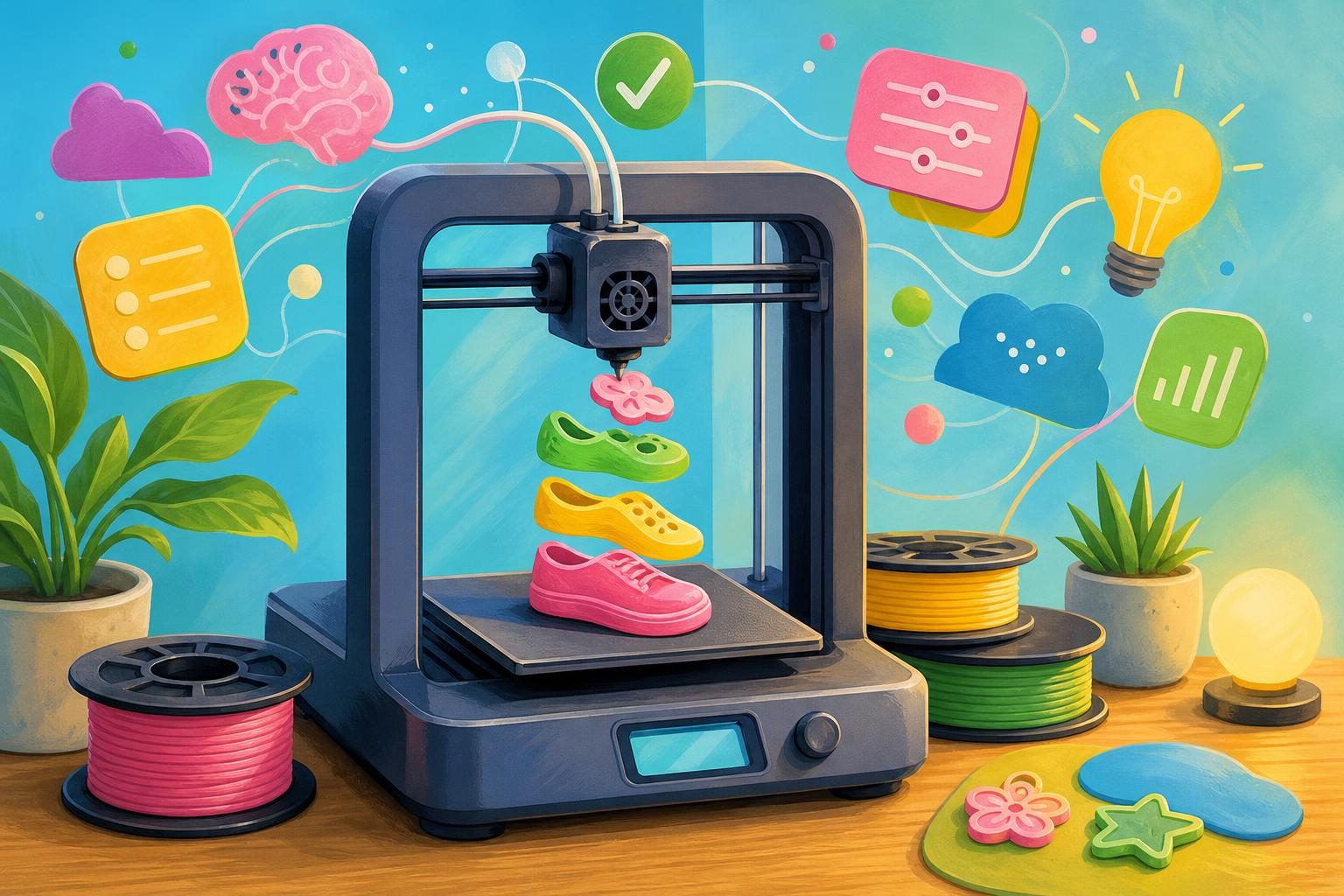
My favourite example from this week involves a 3D printer. My wife wanted one because it looked like fun, and I was initially thinking what any sensible person in a neurodivergent household might think: do we really need more stuff?
But I was blown away by what it could create. Then I had one of those connect-the-dots ideas. My stepdaughter has Crocs, where you can add little charms called jibbits, and she also enjoys fidget toys. Could we make a Croc charm that was also a removable fidget tool?
We used Claude to design the file, printed it and it worked. That is wild to me. We had an idea, used an AI tool to help turn it into a design, and made a physical thing we could actually use.
You do not need a 3D printer to have your own version of this experiment. Use AI to help structure an email, brainstorm a meal plan, tidy notes, think through a work process or develop a creative idea. Start with something you care about enough to play with.
I do think this technology is going to become part of everyday life. There is plenty of uncertainty around where it all goes, and I am not pretending to know the answer. But I would rather learn how to use it thoughtfully to support my life, family and community than sit on the sidelines out of fear.
If you are at the stage of understanding your own thinking style first, the free adult dyslexia quiz can be a useful educational place to reflect.
A grounded way to approach AI without adding more pressure
I’m not suggesting you need to chase every new tool or turn yourself into an AI power user this week. That is a fast route to having even more tabs open in your brain.
Instead, try one tool regularly. Give it a real job. Check its output, use your judgement and see whether it saves energy on work that normally drains you. Test, measure, adjust.
The exciting part for me is that AI may let more of us turn visual ideas, patterns and half-built projects into finished work. The important part is remembering that finished does not have to mean perfect, and more output does not automatically mean a better life.
If this episode gets you thinking, have a browse through the Truth About Dyslexia podcast library for more conversations about the messy, useful and very human reality of adult dyslexia and ADHD.
Try the tool, but keep hold of the steering wheel
My long flight was fine. Singapore was fantastic. The 3D printer made a little fidget Croc charm, which still feels ridiculous and brilliant. And AI continues to make me rethink what is possible for a brain like mine.
For me, how AI can help dyslexic and ADHD brains finish things comes back to one simple point: use it to support your real priorities, not to create an endless pile of new ones. Pick one small task or idea this week and see whether it helps you move it forward.
You do not need to predict the whole future. Just stay curious, protect your energy and give yourself permission to use tools that make the boring bits lighter.
Read the full episode transcript
Okay, bit of an update cast today on the Truth About Dyslexia. We're going to get into a little bit about my holiday, a few things that I've been working on, 3D printers, which are just absolutely awesome, and where I just see the world going. Like, the world seems very messy at the moment, and I think for dyslexic, neurodivergent thinkers, we all need to be thinking about how the game is changing. So I thought I'd share my thoughts on what I would call the game. So let's get into it. Okay, so I just got back from Singapore.
I had eight days over there. It was fantastic. I was thinking back, this is probably the first proper overseas holiday I've had since COVID. You know, when I say proper, I mean, I guess where I've gotten on a plane and I've been on it for seven, eight plus hours. I've done Australia and a couple of local places to New Zealand, but not really big get-on-a-plane-and-go. And, you know, I'll be honest, when we first booked this, like even getting on a plane for that long, I'd kind of built up in my head,you know how our heads work and we overthink things,I was like, Oh, do I really want to get on a plane like that?
Am I just going to be like, am I going to be anxious? Is it going to be really horrible? And what I can say is it's just such a great reminder of how we build silly stuff up in our heads, and then when we get there, we're absolutely fine. I absolutely loved the trip. I was fine on the planes. You know, the ADHD side of my brain really kicks in in some of these situations where we're kind of,we've done all this planning for probably a year.
Different, like, we enjoy setting things up, making sure we know what we're doing, and then when we get there, we kind of go to our plan, but we also go with the flow. Like, if something doesn't work, we don't really care. We just kind of enjoy the system, and we're really good with flicking around with change because on those type of trips, you're kind of, you know, beyond a few big things that you kind of have to be there, like we went on a little cruise ship, or a big cruise ship, should I say, you had to be there at the right time and those type of things, you can kind of play it by ear. How do you feel? Do you really want to do that? Could we shift this and change that?
And I find, like, in those kind of chaotic situations, that's where my ADHD is in such a nice place. Like, I don't have to take Ritalin or anything like that, or Vyvanse, which I actually take. You know, it doesn't matter because we're in kind of this fun, exciting, interesting situation that's really stimulating the dopamine in my brain. And I kind of, I kind of play the game a lot better and really enjoy it. So I was really, had so much fun. Everyone was just, the whole family enjoyed it.
It was such a good reminder of taking a few more breaks. You know, I think with AI and the way the world is going, especially for neurodivergent thinkers, it's opened up this world of so many possibilities, and it just gets more and more and more. And you can actually end up doing too much stuff all at once because your brain can kind of sometimes handle that level of kind of tasking. Like I find, like I kind of feel for a while like I'm thriving in that zone until I'm not, and until the burnout starts to kick in and I start to realize, okay, I've got too many strings all in the air at the same time that I'm pulling on. I need to actually let some of these go and realize the world doesn't end if I just release some. Because it can be so, you know, with AI, and this kind of brings me into another really key part of what I wanted to talk about today from the trip, which was amazing and very valuable for burnout.
But what I wanted to talk about with AI is we're in a world where even in the last 12 months, the level of improvement in some of these systems is unbelievable. Now, you may be just using it to have a conversation and asking it a few questions, kind of like an advanced Google. You may be using it in a much more specific way with code and video and generation and other stuff. But if you're in this industry, like you can see where this is going. Like this is unbelievable. The stuff we are achieving is kind of mind-numbing.
It's kind of really breaking my brain a bit of how fast we have moved. And don't get me wrong, I don't think the world is moving as fast as we think. Like if the lag is huge. But if you're neurodivergent and you can pick things up quickly, like you can, your brain just kind of jumps onto something, sinks its teeth into and starts to absorb it. It's quite powerful. And I don't think we've ever had a technology that kind of works for how our brains work.
Like in the past, you know, the problem was is that we could sometimes get things to 50, 60, 70, even 80 percent. And then we'd get bored and move on, move on. Like with AI, you can actually, AI can not only get you to 80% quicker, it can start doing all the boring things that used to stop you from getting from 80 to 100%. So if you plan yourself well, don't get me wrong, you can't still have 300 things on the go and still achieve it, et cetera. But it's giving us that opportunity for our brains to actually finish stuff. So as long as we do have the right systems in place to vet the ideas we're thinking about or what we want to achieve, AI can help us do the boring stuff that's usually the pain.
Like that never has existed in the past, and in the last three, four years of technological advance, this is game-changing. How this impacts the world, who knows? You know, we can go down that rabbit hole forever. Nobody understands it. And I know there's a lot of fear out there, and it can be very easy to get on that kind of bandwagon of destruction and doomerism. But in the grand scheme of it, none of us listening to this podcast can make a massive impact in that.
Let's be honest, none of us, unless Sam Altman's out there listening to this podcast, which I do doubt, we're not going to really have much of an impact. So all we can do is work towards the betterment of our own lives, our families' lives, and our communities. That's kind of where we're at. So, you know, don't use it to harm others. Great, have that on your list. It's important.
But, you know, you've got to kind of, in my opinion, lean into it and say, hey, we are where we are. How can we use it to better our lives? And, you know, when I first started using this, it was for emails and calendars and stuff. But it's literally altering the way my business works. Like we're building software for companies that just, it's amazing. Like companies are now becoming more effective and efficient.
I'm just loving it. And it's working with my brain's spatial ability. Like if you're dyslexic, you sometimes have this ability to see systems and processes quite visually. You can kind of see how things fit together in the puzzle. And when you can take that and use AI to help turn that into reality, it is a pretty powerful space to be in, I can guarantee you that. And what I would say to anybody listening to this is, if you're not already playing in the space, I just can't, I just can't really tell you enough how.
Make sure you've got a paid account. Make sure you're trying to use it every day. Watch some videos. There's so many YouTube videos out there online. Like, I get quite deep. There's a great podcast called Moonshots with Peter Diamandis and a bunch of guys that talk about this.
It's quite intense. It's quite long for the more geeky out there. But it's for anybody. This is going to become part of our lives. It's not going away. It's kind of like that social media thing.
When it first came out, everyone was kind of like, I'm not too sure. It seems like a giant photo book online. And then it just kind of took over. This is going to be like that, but on steroids. This is going to become so huge in everyone's life. So if you're ahead of the game, there are advantages to be had.
If you want to be winning, like there are advantages to be had. And this can be used in parts of life, health, everything. You know, imagine you're having a nutritionist and a doctor standing next to you. You know, it may not be perfect, but I'm yet to meet a doctor that's perfect either. Do you know what I mean? So, like, it's kind of, it's giving people this connection to intelligence that we've just never had.
Like, I can see, you know, with my brain, like I released a book recently. That was only possible because AI helped me pull my thoughts together. I'm not organized. Let's be honest. That's not my natural skill set. But the editing function was able to be taken out by AI, which is awesome.
Why not? Why not let it happen? You know, so what I would say to you is, if you're listening to this, I just want to make a kind of a plea to everybody out there is make sure you are using this, even if it's just for some fun projects. I'll give you an example. So this is a good way to finish. Finish this podcast is we bought a 3D printer.
Have you seen the 3D printers? It's kind of, you can put something in and it creates something in plastic. And I've seen these. I've kind of never been that interested. If you've seen a neurodivergent household, there's already too much stuff in it. Do we really need more?
I was telling my friend about that, and that was his response to me. And that's the truth, right? We've got way too much stuff. But my wife wanted it. She wanted, like, she thought, hey, this could be a bit of fun, so we did it. And they started creating stuff, and I was amazed, actually, at the quality that this creates.
Like, what an amazing invention a 3D printer is. Like, if you haven't seen one operate live, it's kind of mind-blowing in what it can do. But what's even more crazy is AI tools like Claude are able to actually create files. So I had an idea. You know how our brains work. I had an idea, and I was like, oh, can we connect these two dots together?
My stepdaughter has Crocs, and you get these things that go on a Croc called a jibbit, and she also loves fidget toys. Like, she loves fidgeting. And so I was like, could we create a jibbit that was also a fidget tool that could come off? And she created that. She, I mean, so the AI, Claude, was able to design that, and it was able to come out so that we could operate it. How cool is that?
Like, we were actually able to operate it like that, which was an amazing experience. So we were able to take that, put it in, and actually print it out and get it to work. So what an amazing world we live in when that is actually a possibility. So on that note, like, all I would say is try different things. Don't get stuck. Test, measure, adjust, because this will be a game changer in the long run.
Until next time, I've been Stephen from the Truth About Dyslexia.
Recognise some of this?
Take the free quizSee which adult dyslexia traits feel familiar.
This short quiz is educational and gives you a useful next step.
Keep exploring this topic
Useful reading and listening for your next step.
Listen next