



Truth About Dyslexia podcast
My Vyvanse Routine, ADHD Overstimulation and Letting 94% Be Enough
I’m sharing what I’m trialling with Vyvanse, from walking and eating before work to avoiding caffeine, plus the perfectionism lesson behind an office that is 94% right.

Listen to this episode
My Vyvanse Routine, ADHD Overstimulation and Letting 94% Be Enough
Open this episode in Spotify

Follow the podcast and keep the next episode close.
What you will take from this episode
- My experience has taught me that medication is not a standalone answer. I have to work out how it fits into my actual life.
- Too much stimulation can feel worse than not enough focus, so I pay close attention to caffeine and the pace of my day.
- A walk, a protein-focused breakfast and a pause before work are parts of the routine I’m currently trialling.
- Perfectionism gets less power when I notice what is working instead of only staring at the unfinished 6%.
- Progress with dyslexia and ADHD rarely moves in a straight line. Awareness makes it easier to reset rather than beat myself up.
When focus comes with a side of overstimulation
Have you ever found something that helps your brain focus, then realised it also asks you to get much more intentional about the rest of your day? That has been my relationship with ADHD medication.
I’m back trialling Vyvanse, and this is my third round of figuring out how it works for me. I was diagnosed with ADHD later in life, or perhaps more accurately, it took me time to accept that diagnosis. I tried Ritalin and Concerta before Vyvanse became available in New Zealand. Vyvanse has generally been the one that has worked best for me personally.
But “works” does not mean it is effortless. One of my biggest challenges has been feeling burnt out by the end of the day, especially if I let everything stack up in the wrong direction. This article is an update on what I’m noticing, not medical advice or a routine for anyone else to copy.
If you are trying to make sense of the overlap between an ADHD brain and dyslexic thinking, the adult dyslexia podcast has plenty more honest conversations to explore.
My Vyvanse routine for ADHD overstimulation is built around the day
The big lesson for me is that medication does not just work in isolation. I need to work out how it works in my life, with my energy, food, movement and the kind of day I’m planning to have.
At the moment, I’m trialling taking Vyvanse six days a week, with time off to let my body reset. I also find it works better when I have a clear idea of what I want to achieve. If I take it on a day when I plan to lie in bed or drift about doing very little, it does not have the same effect. My body feels like it wants somewhere for that energy to go.
I take it first thing in the morning, then go for a walk. My usual walk is around four or five kilometres and takes about an hour. It is mostly flat with a few hills. For me, moving early helps create a better starting point as the medication kicks in.
I’m sharing the structure because it may help you notice the wider conditions around your own focus. It is not a replacement for working with the clinician who prescribes your medication. I’ve learned the hard way that the details matter.
I’ve also spoken before about the way food, body goals and ADHD can pull in different directions. my earlier episode on Vyvanse, Wegovy and keto is another honest look at that part of my experience.
Why I skip regular coffee and prioritise food
I get overstimulated quite quickly. It is a real bugger, because ADHD already has you trying to find enough stimulation to focus, while another part of you can tip into a fuzzy, overcooked state if you push too hard.
Caffeine is one of the things I watch most closely. When I take Vyvanse in the morning, I stick with decaf rather than smashing a big long black alongside it. That combination does not work well for me. The dose I take is also something I have had to find with my prescriber over time. Bodies respond differently, and my experience will not be everybody’s experience.
After my walk, I have been making a breakfast around Greek yoghurt and protein powder, with fibre and a little cereal. I’m not naturally a big morning eater, and I used to fast until far too late. What I noticed was that I would get far hungrier later in the day, and that pattern was not helping me.
If caffeine is part of your own ADHD puzzle, you may also find my episode on nicotine and caffeine for ADHD and dyslexia useful as a personal exploration of the topic.

Creating a gap before I rush into work
After breakfast and getting ready, I sit down to meditate for around 20 minutes. I’m lucky that I work from home and have an office there, so I can shape my mornings this way.
When Vyvanse has kicked in, meditation feels noticeably different for me. My brain is more able to do what I ask of it. More importantly, the pause stops me from charging straight into the next task simply because my brain has found some momentum.
Later in the day, I’m also trialling Added Sleep, the supplement I created, at different points between midday and mid-afternoon. What surprised me is that it has not been the dramatic “put me to sleep” product I originally imagined. In my experience, its more useful role has been helping me feel calmer in the evening as I come down from work mode.
I shared more about that unexpected lesson in what I learned when my sleep supplement did not work as expected.
Perfectionism is often the gap between the picture and reality
The other thing on my mind lately is perfectionism. I see it often with dyslexic and ADHD thinkers, and I definitely know it from the inside.
Many of us can build incredibly vivid pictures in our heads. The problem comes when real life cannot quite match the picture. It might be an idea, a work project, your home, a creative piece or something as small as the little nook I built in my office.
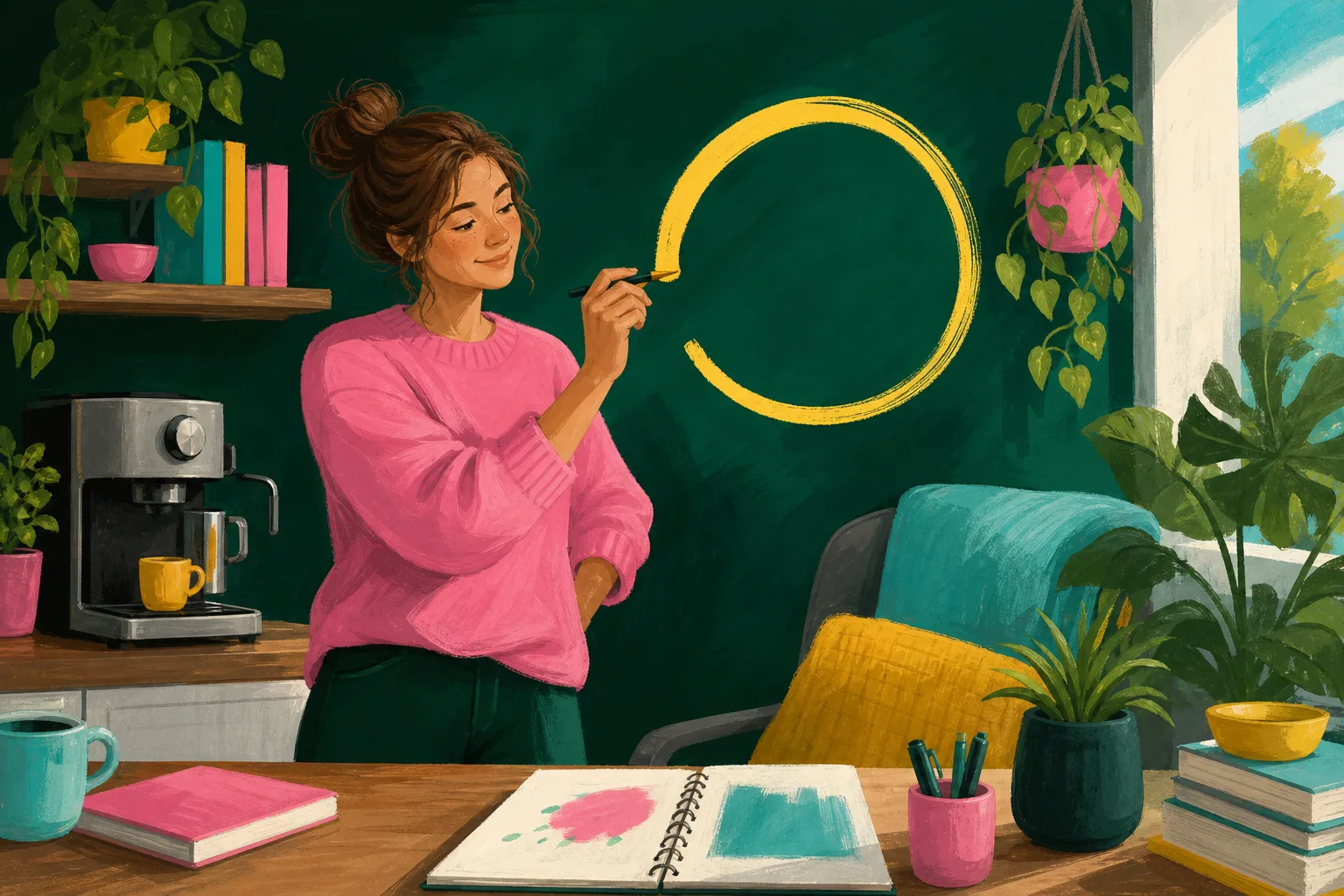
I like the nook. It has wood, a coffee machine, a bar fridge and dark green brick wallpaper. But the lights around the edges are beginning to come away, and because the walls were not perfectly straight, the wallpaper is ever so slightly off at the top. In the past, that would have hit me hard. I would have been furious that it was not exactly right.
Now I can usually see it differently. It is about 94% perfect, which is pretty darn close. The final 6% may still annoy me, but it does not need to cancel the 94% that exists. When something feels like it is all going wrong, it can be worth doing the numbers. Are you seeing failure, or are you seeing a mostly good result through the magnifying glass of perfectionism?
Consistency is not about producing a perfect result every time either. how I stay consistent with a neurodivergent brain is a useful reminder of how I try to keep going when neurodivergent energy is all over the place.
There is no straight-line version of self-acceptance
I wish I could tell you that once you have enough awareness, you graduate from overthinking, overstimulation and perfectionism forever. I do not think that is how it works.
For me, there are stages. In some areas of life, I can notice things hitting the fan, take a breath and move on. In others, I am still very much learning. The win is not becoming some perfectly calm angel who never gets caught up. The win is catching it sooner and giving myself permission to take a knee.
My practical next step this week is simple: notice one part of your routine that is adding stimulation, and one thing that gives you a steadier base. Then look at one “not perfect” thing in your life and ask whether it is actually 80%, 90% or 94% done. You might not need to fix it all today. You may just need to let the good bit count.
If you are carrying the feeling that everyday life takes more out of you than it seems to take out of everyone else, you are not lazy or broken. why dyslexic and ADHD adults can burn out from everyday life may help put some language around that exhaustion.
Keep testing, keep noticing
This is just a snapshot of my crazy dyslexic ADHD life at the moment. Vyvanse, walking, decaf, protein, meditation and being a little kinder about crooked wallpaper are all things I’m learning from in real time.
Your version may look completely different. But if you can move from “why can’t I get this perfect?” to “what is helping, what is overstimulating me, and what is already good enough?”, that is a very solid place to start.
Read the full episode transcript
Vyvanse and starting to take that again, the challenges with perfectionism and overthinking things, and just a general update on my crazy dyslexic ADHD life. Let's get into today's episode on the truth about dyslexia. Okay, I haven't done an update cast in a while, and I know there are still some listeners who really enjoy these, trying to understand and pick apart some of the learnings I'm having in my life as I go around in circles like the Tasmanian devil. You know, I think that's really key with talking about neurodiversity, is that it's really not a straight line. And like I've mentioned this in previous episodes, you know, you kind of wish you kind of reach different levels in life, like across everything. And I do really believe there are stages you kind of reach of awareness, and each of those stages gets you a little bit closer to, I guess, self-acceptance is probably the phrase I would say, like that ability when things kind of hit the fan, you kind of just accept it and you can breathe through it and you can move on.
And in parts of my life, I'm really reached that. Other parts, I'm still learning. And so I thought I'd share a couple of things today. So one of the things I'm back trialling is Vyvanse. So, you know, my story with ADHD meds has been up and down. I found out quite late I had ADHD, or was willing to accept that diagnosis, as we do, as we all learn, and it's a bit of a journey.
But when I realised and started taking it, I tried Ritalin was early on, and I think there was another one starting with C. I can never remember the name of it. Concerto, was it? And Concerto didn't really work. Ritalin did a bit better, and it wasn't until Vyvanse got accepted in New Zealand that I kind of found something that kind of worked for me. The problem I had was, and I've kind of gone on and off it maybe twice, maybe three times now, and I'm back on it for the third round, is my biggest challenge was at the end of the day I would be quite burnt out.
And so I try to heap the different things. And, you know, what I can always say with any of these drugs, one, you've got to try a bunch of them, I think. If one's not working for you, don't give up on the others. I've learned that over the years. I have to find Vyvanse is one that's always worked. That's great.
And you find one that has the least side effects or the least stuff that you have to mitigate. But the second piece of it is, is that it's not something on its own that just works. You've got to kind of work out how does it work in your life. So I thought I'd give you a few tips and tricks that I've found why I started again in kind of what is working. So first and foremost, my kind of rule is I take it, I'm starting to take it six days a week. I think you definitely need one or two days off of it to let your body kind of reset.
That's what I've learned, is if you take it every day, your body just kind of gets strung out. I definitely know people who take it occasionally when they need to do certain admin tasks or stuff that's really that type of heavy in their life. I kind of find myself better, you know, Monday to Friday and then sometimes on a Saturday as well, especially if I want to get up and be productive. That's probably the key thing. I find it much better on days when I know what I want to achieve. So, like if it's a day where I'm just going to lay in bed or just chill out or not really do much, it doesn't have quite the same impact because it's kind of like my body wants to do something.
It wants to kind of have goals it can achieve, which is a really cool thing, right? If you've got ADHD, that's like not something that always happens. It's not a natural process. You know, you usually do things in opposite ways and mess around. But my biggest challenge has always been, like, what I've kind of learned from taking Vyvanse over the years is, one, I can't really have a lot of caffeine on it. So especially when I take it in the morning, I have to have decaf coffee with it.
I can't hammer, you know, a big long black full of caffeine and my Vyvanse. It just doesn't work. I personally take the 30 milligram dose, not the 50. I find the 50, again, just overstimulates me. You know, I think certain people have different gene types and different ways our bodies respond, in simple terms. And my body gets overstimulated quite quickly.
It's really painful, actually, to have ADHD but also this trouble with overstimulation. It's a real bugger, is the term we would use in New Zealand. It's a real pain because what happens is if I try and overdo my dopamine or try and push that side of my body too much, I get locked in this kind of fuzzy overstimulated state, which is sometimes worse than we are not stimulated enough to be focused. So I'm kind of always balancing between these two worlds, and it's kind of, it's probably the biggest reason I come on and off of Vyvanse from time to time while I kind of learn my process. Now, what have I learned that's helped? If I go for a walk in the morning, that really helps me.
So I'll take my, here's my kind of process at the moment. I take Vyvanse first thing in the morning when I wake up. I also have some NAC, which is another thing which helps with homocysteine, a little bit of selenium, and some, what are they called? Electrolytes. And so that kind of gives my body a foundation. I then go for a walk, and my walk is about four or five Ks, not overly inclined.
There's a few little hills around, but mainly relatively flat, and it's about an hour long. Now, whenever I do those things together, it really helps because that kind of clears the overdopamine that kind of has kind of, or the cortisol even that's starting to come up from the morning, and that really helps. And as the Vyvanse kicks in, it's kind of like I'm on a good playing field. Also helps with my digestion, go for a walk in the morning. The second thing I do is after that walk is I'll come straight back. I won't have a coffee or anything.
I will, I kind of, I was listening to a podcast with Tim Ferriss and a guy called Henry Brooks, Arthur Brooks, Arthur Brooks, I think it was. He's a guy who talks about happiness. And this is so the way my brain works, this whole thing about happiness and purpose and stuff. The one thing I learned from him was what he eats for breakfast. And I know this sounds crazy because it's the weird stuff we pick up in podcasts that are valuable, you know, that one or two gems. And he talked about how he tried to get protein in in the morning, and he has Greek yogurt and whey protein because he can get 40-plus grams of protein, one hit, doesn't feel like a huge amount of food.
Like, I'm not a big morning eater. But what I do notice is if I have at least 30-plus grams of protein or a good hit of protein in the morning, I'm in a better space. So what I do now is I have Greek yogurt, a dash of olive oil, and it's just because it is one of the best oils and there's a lot of other benefits to it. I throw in a little bit of, I have some powdered fiber stuff in there, just a little bit, and then a big hunk of protein powder, some chocolate protein, ISO 100, something or the other. Heaps of good ones out there to find in your local area. And then I have like a little bit of kind of like cereal in it, some healthier cereal, which again gives me a bit of fiber.
I think, you know, one of the things I always have to watch is making sure I do get some fiber with what I'm eating. So yeah, so that's really key. And so the great thing about that is it gives me a real base in the morning of protein because I can sometimes fast until way too late. And I used to think that was a good thing; it would keep me thin and healthy. But nine times out of ten, unless I'm doing something like keto or carnivore, I then just get much hungrier in the evening and it doesn't work. So like what I've really learned to do is have that protein hit in the morning, I'm in a good space.
I'll then go and have a shower, get ready, get changed, and I'll come down and meditate. And I'll usually have a decaf cup of coffee at that point, and I'll have between five and 15 grams of creatine in that coffee, with that decaf coffee with a bit of L-theanine. L-theanine for me just takes the edge off everything. I'm probably, I probably have more than most average people throughout my day, and that's been really useful. And I'll kind of just sit and I'll do a 20-minute meditation. When Vyvanse has kicked in, those meditations are amazing.
My brain just does what it's told, and that's such a nice place to be. Like, yeah, if you've never had Vyvanse and you've got ADHD, it really does change the game a bit. For me personally, this is not medical advice, but my personal experience. And so that's really good. The meditation helps me just kind of calm down, not rush into the next thing that's on my list, which is easy to do. I'm lucky that I work from home and have an office at home, so I can build my process around that, which has been really valuable for me.
So it's kind of, it's kind of a morning routine. When I get into work, I get into life. As the day goes on, I'm trying to have, like, larger lunches that are high protein. So my food of choice is probably Nando's if I can go out and eat. So I'll go and eat some chicken, probably, yeah, a good amount of chicken, like it's probably 60 to 80 grams of protein usually in that hit. And I kind of make that my main meal of the day.
And so it's taken me a long time to get to this point. I used to be shocked at eating lunch and breakfast, but I've realized over time it is the process. I'll then about three o'clock have another protein shake. This usually has blueberries and strawberries, has a little bit more sugary kind of berries in it, which kind of gives me like a little hit to get me over the edge. And I also take Added Sleep, which is that supplement I created at addednutrition. co.
nz. Now, what I learned about this, I think I've mentioned this in other podcasts, is what I've learned about this supplement is it does not put you to sleep. I created a supplement that does not put you to sleep. This is probably why you haven't heard me talk about it quite as much. But what it actually does do very well is it calms me down massively, which is oddly even more valuable to me. But it's not what I originally thought it was going to do.
I thought it was going to knock you out and make you sleep better. What it actually does is I have it between, usually between midday and 3 p. m., and I trial different spaces there. And what it does is it kind of calms my nervous system in the evening, so I can kind of switch off work and go a bit more into life. It means that I'm not quite as hyper, especially when you're coming off, like I find with my Vyvanse, it can linger for a while.
And it actually does help me sleep, but not for the reason I thought it would help me sleep. It helps me sleep because my body's calming down rather than it kind of like being a punch to the head. Does that make sense? Kind of thing. So Added Sleep's actually been really good for me. I really recommend it for people on ADHD meds, but, you know, just from my personal experience.
But yeah, like it's hilarious that that's how it works. But that's what I wanted to share today on that side of things, guys, because that's kind of what my life, you know, what I've been testing out around Vyvanse and how that operates. The other thing as well that I've been playing with, I mentioned in the beginning, was around perfectionism. This is something I see so often with dyslexic, ADHD thinkers, especially in the dyslexic space. So many of us can create such vivid worlds that seem, that are so real in our heads that we struggle so much to get them to appear into reality as we see them. It just doesn't happen.
You know, as I'm recording this podcast, I do most of my podcasts by voice so I can walk around. Helps with the ADHD. I'm like looking at this little nook area that I created in my office. It is like 94% perfect. Like, it looks great. The wood is great.
There's a coffee machine. I've got a little bar fridge. It's really cool. I got like these dark green brick wallpaper. But then the lights around the edges are starting to come away, and I haven't fixed them. The walls were never quite straight, so the wallpaper at the top is ever so slightly off angle, which, I don't know, if you're anal like me, sometimes that really annoys you.
And like in the old days, I used to, I would have like cried and gone, Why has this not worked out perfectly? You know, I would have broken down and got real frustrated. Nowadays I'm just like, Ha, oh life. Hey, I got to 94%. That's better than majority of the world, right? I got it to pretty darn close.
And like, I can't stress this enough. If you're struggling in a part of your life where you just feel nothing's going right, really do the numbers. Maybe you are actually getting 80% of what you want. You're going, Great. But that last 20% is, it's kind of like a punch in your kidneys, and you're like, Ouch, I don't want to deal with this. Why is this what I have to deal with in my life?
And it just becomes painful. Like, I've experienced that. And the more I let it go, and I get caught up in that from time to time, don't get me wrong. Like, no, there's no angels on this planet Earth, I'll tell you that. Everyone goes through this. But more often than not, I will realize what I'm doing, and I'll let myself take a knee and have a rest.
Does that make sense? I just thought I wanted to share that because, you know, I've had a couple of moments this week where I've seen it more in other people. But I can, you know, when you see something in other people, you usually see it in yourself as well. You know, humans are great relational machines. When we see something in life, we relate it back to ourselves. So when I see other people having this problem, it just reminds me of the struggles I've had over the years.
So that's what I want to share today, guys, on this update cast. I might try and do more of these. They're so valuable for myself, just getting out of my head what I'm doing and what's working, and reminding myself what progress I'm making. You know, can't beat that. So have an epic rest of your day. If there are any podcast topics you want, remember to reach out to us at truthaboutdyslexia.
com. I'm always open to doing that. Have an epic rest of your day. Thanks for listening to the Truth About Dyslexia. This podcast is sponsored by Added Nutrition and our new product, Added Sleep. It's designed for brains wired differently.
If you want to sleep better, maybe give it a try. Use the code Truth About Dyslexia to get a $10 credit on your order at addednutrition. com. Link in the show notes.
Recognise some of this?
Take the free quizSee which adult dyslexia traits feel familiar.
This short quiz is educational and gives you a useful next step.
Keep exploring this topic

Useful reading and listening for your next step.

Listen next